


Research scope and principal findings

This guide examines sleep apnea statistics in the US, with a focus on obstructive sleep apnea, oral appliance therapy, and treatment access in Champaign and Rantoul, Illinois.
It focuses on developments from 2021 to August 2026 and considers how sleep apnea diagnosis and treatment may continue to develop after 2026.
National research shows that sleep apnea care is expanding beyond a single treatment approach.
Diagnosis may involve home or laboratory sleep testing, while sleep apnea treatment can include positive airway pressure, oral appliance therapy, weight management, and other approaches based on the patient’s needs.
Oral appliance therapy provides another treatment option for appropriate patients with obstructive sleep apnea.
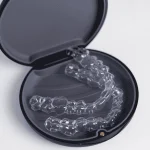
Custom mandibular advancement devices are fitted and adjusted by qualified dental professionals, with ongoing monitoring helping assess comfort, effectiveness, and changes in oral health.
For patients in Champaign and Rantoul, IL, continued coordination between medical and dental providers can support the path from sleep apnea evaluation to appropriate treatment.
This guide examines national trends alongside local considerations to better understand how oral appliance therapy fits into the changing landscape of sleep apnea care.
National burden and changing treatment patterns
Obstructive sleep apnea involves recurrent narrowing or obstruction of the upper airway during sleep.
Symptoms can include loud snoring, witnessed pauses in breathing, choking or gasping, excessive daytime sleepiness, cognitive problems and mood changes.
Estimates vary according to diagnostic thresholds: the US Preventive Services Task Force reports that, among adults aged 30–70, symptomatic mild-or-greater OSA was previously estimated at 14% of men and 5% of women, while moderate-to-severe OSA was estimated at 13% and 6%, respectively.
The American Academy of Dental Sleep Medicine cites an estimated 54 million US adults with some degree of sleep apnea.
Untreated OSA is associated with cardiovascular and cerebrovascular disease, type 2 diabetes, cognitive impairment, reduced quality of life, motor-vehicle crashes and, in severe cases, greater all-cause mortality.
Nevertheless, the USPSTF concluded in 2022 that evidence remained insufficient to recommend either for or against population-wide screening of adults who do not recognise or report symptoms.
That conclusion does not apply to patients who present with symptoms or clinical concerns, for whom evaluation and diagnostic testing remain appropriate.
Positive airway pressure, particularly continuous positive airway pressure, remains the primary treatment because it generally produces the greatest reduction in respiratory events when worn.
However, mandibular advancement devices are an established alternative for patients who prefer them, experience adverse effects with positive airway pressure or cannot use it consistently.
The national model is therefore shifting from a simple “CPAP first or no treatment” approach towards shared decision-making involving positive airway pressure, oral appliances, weight management, oral surgery, neurostimulation and, for selected patients, medication.
This diversification accelerated during the study period. In December 2024, the US Food and Drug Administration approved tirzepatide as the first medication specifically indicated for moderate-to-severe OSA in adults with obesity, alongside a reduced-calorie diet and increased physical activity.
In August 2025, the FDA approved the bilateral Genio hypoglossal-nerve stimulation system for selected adults with moderate-to-severe OSA who have failed, cannot tolerate or are ineligible for standard options, including positive airway pressure, oral appliances and pharmacotherapy.
These developments are likely to encourage more phenotype- and preference-based treatment after 2026 rather than displace oral appliances altogether.
Effectiveness and limitations of oral appliance therapy
The most common oral appliance advances and stabilises the lower jaw during sleep, helping to reduce upper-airway collapse.
Clinical guidance recommends a custom-made, titratable appliance rather than an over-the-counter or non-custom device.
The patient should first receive a medical diagnosis and treatment order; a qualified dentist then assesses dental and jaw suitability, fits and adjusts the appliance, manages adverse effects and coordinates follow-up with the treating medical practitioner.
Given this, at CU Dentists, patients can discuss dental approaches to sleep apnea care and whether oral appliance therapy may be appropriate for their needs.
Oral appliances usually do not suppress the apnea–hypopnea index as strongly as optimally used CPAP, especially in severe disease.
Their practical value comes from comfort, portability, lack of masks and tubing, absence of machine noise and, for some patients, greater willingness to use the treatment throughout the night.
The USPSTF evidence review found that mandibular advancement devices can improve apnea–hypopnoea index, sleepiness and blood pressure in clinically referred patients, although evidence connecting treatment to long-term mortality or cardiovascular-event reductions remains limited.
Long-term results are encouraging but should not be overgeneralised.
A 2020 ten-year follow-up study found that both mandibular advancement therapy and CPAP could maintain stable treatment effects among patients who remained in follow-up.
Because long-term studies include selected patients who tolerated and continued treatment, they do not establish that every newly treated patient will remain successful for a decade.
Adherence is affected less by age, sex or baseline severity than by comfort, side effects and early treatment experience.
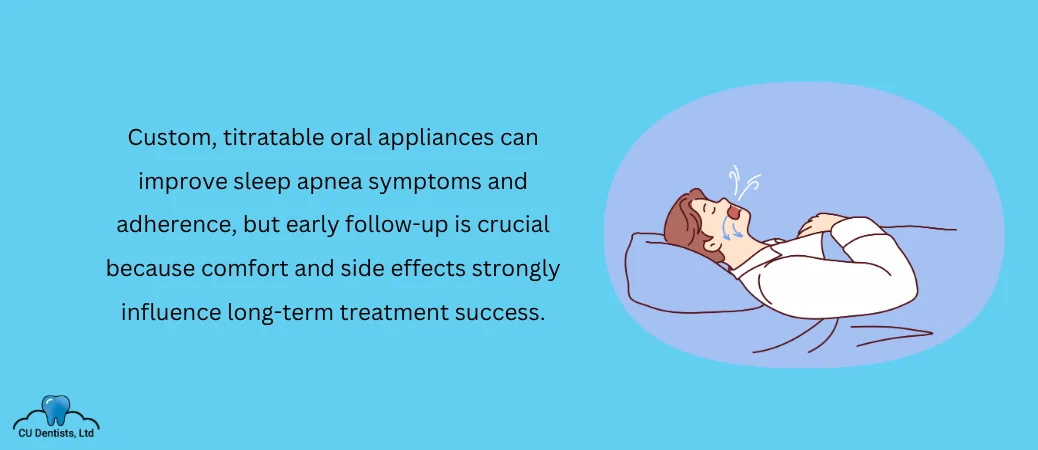
A 2021 systematic review found that non-adherent oral-appliance patients reported more adverse effects and commonly discontinued within the first three months; custom-made devices were preferred and associated with better reported adherence than ready-made appliances.
This supports intensive early follow-up rather than issuing the device without structured adjustment and outcome verification.
Potential adverse effects include dental or oral soreness, excessive salivation, dry mouth, jaw discomfort and temporomandibular-joint symptoms.
Longer use may change tooth position, overjet, overbite or the way the teeth meet.
In short-duration trials reviewed by the USPSTF, reported oral, dental or jaw symptoms varied widely, illustrating both the frequency of minor problems and the inconsistency of adverse-event reporting.
Regular dental examinations and appliance adjustments are therefore integral to therapy rather than optional maintenance.
Access in Champaign and Rantoul
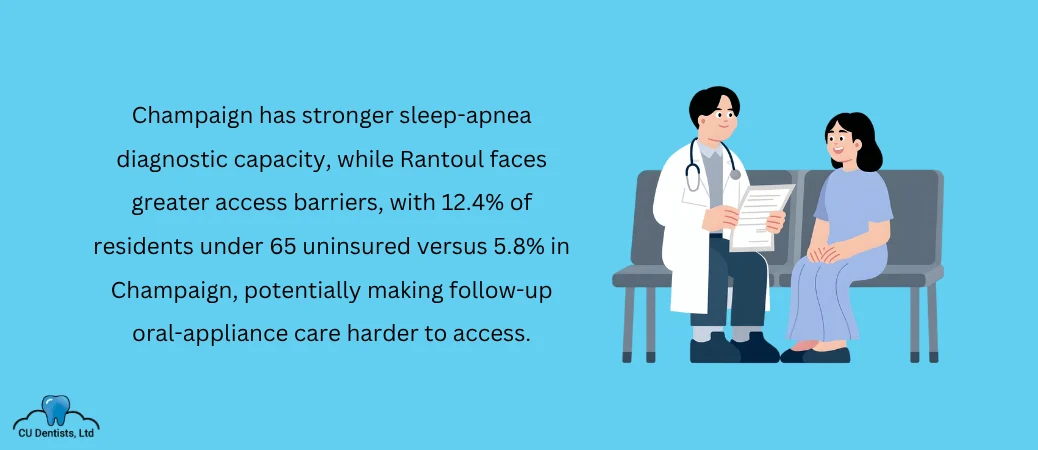
Champaign has a comparatively strong medical entry point for sleep apnea care.
Publicly available information identifies sleep laboratories and clinics, sleep physicians, polysomnography, split-night testing, positive-airway-pressure titration, home sleep apnea testing, CPAP consultations and durable-medical-equipment referrals in the area.
This indicates meaningful local capacity to identify OSA and initiate conventional treatment.
The pathway is less transparent for oral appliance therapy.
The sleep-medicine information clearly describes testing and CPAP services but does not publish a local count of qualified dental sleep-medicine practitioners or a standardised referral pathway for mandibular advancement devices.
The AADSM standards emphasise that effective oral-appliance care requires collaboration between a diagnosing medical provider and a dentist with suitable sleep-medicine training.
Consequently, the relevant access measure is not the number of ordinary dentists but the number accepting medically referred OSA patients, participating with medical insurers and providing titration plus follow-up testing.
Rantoul residents may also access sleep medicine services available across the surrounding region.
The reviewed OSF HealthCare sleep-clinic directory lists several Illinois locations but does not list a sleep clinic in Rantoul; the directory should not be interpreted as a complete census of all independent providers.
Public sources likewise do not provide reliable Rantoul-specific figures for OSA diagnosis rates, oral-appliance prescriptions, treatment waiting times or completed referrals.
The demographic context indicates unequal capacity to navigate this fragmented pathway. Rantoul’s estimated 2025 population was 11,991.
Among people under 65, 12.4% lacked health insurance, compared with 5.8% in Champaign.
Rantoul’s 2020–2024 median household income was $48,691, versus $56,118 in Champaign; household broadband subscription was 83.8%, versus 91.4%.
Rantoul also had a higher under-65 disability rate, 12.0% versus 7.5%.
These differences support the inference that appointment travel, unpaid time, telehealth, cost-sharing and repeated dental visits may be more difficult for Rantoul patients, although dedicated patient-level research is needed to confirm the size of those effects.
Insurance, affordability and coordination gaps
Medicare treats a custom mandibular advancement appliance as durable medical equipment under code E0486 rather than as a routine dental benefit.
Coverage requires an in-person clinical evaluation, a qualifying Medicare-covered sleep test, an order issued after review of the test, and provision and billing by a licensed dentist.
Meeting these requirements is important for coverage eligibility.
Illinois Medicaid’s 2025 durable-medical-equipment schedule also lists E0486 and indicates that prior authorization is required.
This confirms that a coverage mechanism exists, although the fee schedule alone does not provide information about local provider participation, authorization timelines, or individual patient costs.
These remain useful areas for further research in Central Illinois.
Coverage for oral appliance therapy can involve both medical and dental systems.
The sleep study and diagnosis may be handled through medical coverage, while the appliance may be classified as medical durable equipment.
Related dental care may fall under separate dental benefits. Understanding these different coverage requirements can help patients navigate the treatment process more effectively.
For Champaign and Rantoul, IL, coordination between medical and dental providers can help patients move from diagnosis to appropriate treatment.
Telehealth may support some consultations and follow-up, while appliance impressions or scanning, delivery, adjustments, and dental examinations generally require in-person care.
Continued coordination can help make each stage of oral appliance therapy clearer for patients.
Outlook and research agenda beyond 2026
After 2026, home sleep apnea testing is likely to remain an important part of expanding diagnosis because it can reduce laboratory demand and travel for appropriately selected adults.
Oral appliances are also likely to remain an important non-invasive treatment option as sleep apnea care becomes more personalized.
Treatment decisions may increasingly consider factors such as disease severity, airway anatomy, treatment tolerance, weight management, and patient preference.
Future research can provide a clearer picture of how patients move from sleep apnea diagnosis to treatment.
Useful measures include the availability of qualified dental sleep medicine providers, referral patterns, oral appliance use, treatment timelines, and follow-up care.
Studying these factors can help identify opportunities to make the treatment process easier for patients.
Outcome research can also compare CPAP and oral appliance therapy by looking at adherence, follow-up sleep testing, symptom improvement, residual apnea-hypopnea index, dental side effects, and treatment continuation.
These findings could provide a better understanding of which treatment approaches work well for different groups of patients.
For Champaign and Rantoul, IL, continued coordination between sleep medicine and dental providers can help support access to appropriate treatment as sleep apnea care expands.
Future local research can provide a clearer picture of oral appliance use, referral patterns, treatment outcomes, and patient access across both communities.
References
FDA Approves First Medication for Obstructive Sleep Apnea | FDA
Long-term obstructive sleep apnea therapy: a 10-year follow …
Factors influencing adherence to oral appliance therapy in …
Sleep Clinics | OSF HealthCare
U.S. Census Bureau QuickFacts: Champaign city, Illinois