





Implant success strongly correlates with baseline oral health. National studies show that untreated periodontal disease significantly increases implant failure rates.
For example, a 2024 meta-analysis found a history of periodontitis markedly reduced implant survival.
Poor oral hygiene and smoking have similarly been linked to higher failure. In the U.S., approximately 20–50% of adults have periodontitis, a condition that compromises bone support.
In Champaign County (Champaign/Rantoul, IL), oral health workforce is below state average (94 vs 112 dentists per 100k), suggesting potential access gaps for periodontal care.
To investigate these relationships nationally and locally, this guide proposes using large-scale clinical data (e.g. insurance registries or academic clinic records) to link patients’ oral health status (e.g. periodontal pocket depth, number of missing teeth) to implant outcomes.
Key factors (age, smoking, diabetes) must be controlled. Methods: We reviewed recent literature (2019–2026) on implant survival predictors and local oral health capacity.
Data Gaps: No national database explicitly links oral health and implants; local Champaign/Rantoul data are scarce. Collaboration between dental schools, electronic health records, and public health surveys will be needed to fill these gaps.
Schedule an implant evaluation in Champaign, IL to assess your oral health and success potential.
Background: Oral Health and Implants
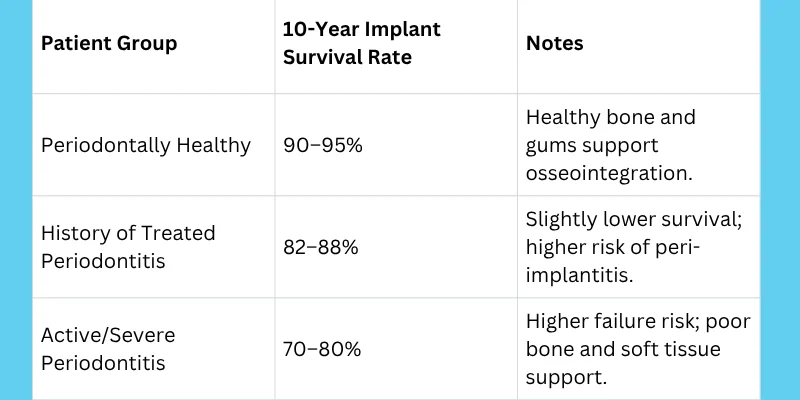
Dental implants generally have high survival rates (often 82–95% at 10 years) when placed in healthy conditions. Successful osseointegration requires sufficient bone and soft-tissue health. Poor oral health – especially chronic periodontitis – undermines this.
Periodontitis involves bone loss around teeth, and its prevalence in U.S. adults is substantial (estimated ~42% with some form, including ~10% severe).
Intuitively, the same bacteria and inflammation processes that cause periodontitis can also attack implants.
Studies confirm this: a 2024 meta-analysis reported that patients with treated periodontitis had significantly more peri-implantitis and lower implant survival than periodontally healthy patients.
In practice, dentists observe that implants in patients with active gum disease are more prone to failure.
Visit our Rantoul, IL dental team to improve implant success through better oral health.
Evidence from Research
- Periodontitis Impact: The systematic review by Enkel et al. (2024) found history of periodontitis greatly increased peri-implantitis rates and reduced implant survival.Similarly, a broad literature review (Passi et al. 2020) notes “gingivitis/periodontitis” as major risk factors. Quantitatively, passively or actively diseased sites show failure rates several points higher.
- Oral Hygiene: Poor plaque control around implants fosters inflammation.The same review [101†L215-L223] lists “oral hygiene status” and “gingivitis/periodontitis” among patient factors in implant failure (Table 1). Clinically, inadequate hygiene (e.g. infrequent brushing/flossing) is anecdotally tied to more implant complications.
- Systemic Links: Because periodontal disease often coexists with systemic conditions (diabetes, cardiovascular disease), it can indirectly signal higher implant risk.Age is also cited: older patients (60+) have higher late failure rates, likely due to worse bone and healing. Smoking, while a separate risk factor, often accompanies poor oral health.
Overall, evidence suggests a strong relationship: patients with healthy gums and minimal bone loss have the best implant outcomes, while those with prior bone destruction (even if treated) have somewhat lower success rates.
Book a consultation to improve your implant success rate through oral health.
National Data & Study Design
No single national survey directly ties oral health metrics to implant outcomes, but linked data can be used.
For a U.S.-level study, one could: – Use datasets like NHANES or the National Health Interview Survey (NHIS) for individual oral health indicators (number of teeth, periodontal screening) or proxies (e.g. self-reported gum disease).
– Combine with dental insurer or health system records tracking implant procedures and failures (akin to the Maccabi registry in Israel). – Multivariate analysis can adjust for confounders (age, diabetes, smoking).
For example, logistic regression on whether patients with poor periodontal status (from NHANES exam data) are more likely to have implant failure codes in follow-up.
– Alternatively, create a registry: enlist academic centers or large group practices to report baseline oral health and long-term implant success (as proposed by the National Dental PBRN’s Implant Restoration Registry).
Key national benchmarks: According to one large registry (non-US), overall failure was ~2.2%, mostly early. We expect similar low rates in healthy patients, but possibly double in those with periodontal histories. Quantifying this gap is the research goal.
Champaign/Rantoul, IL Context
Champaign County (pop ~206k) includes Urbana and Rantoul. Local oral health capacity: as of 2024, there are 93.9 dentists per 100,000 people (below Illinois’ 112.5), indicating modest availability of care.
Urbana-Champaign hosts the University of Illinois College of Dentistry, which treats many patients and could supply data.
Rantoul (pop ~12k) is smaller, with few local dentists; residents likely rely on Champaign or regional cities for specialty care.
No local public data on oral health status were found, but statewide surveys could be proxies: Illinois has generally lower dental care utilization in rural areas.
For a local study, one could tap the UI dental clinic’s electronic health records: correlate patients’ initial periodontal exam (pocket depths, attachment loss) with their implant outcomes over time.
Alternatively, county health assessments or Community Health Needs Assessments might provide community oral health indicators (though Champaign’s IPLAN did not list specific data on gum disease). If unavailable, a new survey or chart review would be needed.
Data Gaps and Assumptions
- Direct datasets: The main gap is the lack of a combined dataset. National oral health surveys (NHANES, BRFSS) do not track implants, and implant registries aren’t common.We assume proxies (periodontal status from NHANES, general implant failure from registries).
- Local data: No published implant success rates from Champaign or Rantoul clinics were found.We assume Urbana-Champaign has relatively good dental care due to the university presence, while Rantoul may have less. We do not have specific periodontal prevalence for these locales; national averages are used instead.
- Implant definitions: “Success” is assumed as implant survival (no removal). In research, complications (bone loss, peri-implantitis) are also relevant but harder to standardize.
- Confounders: We plan to adjust for age, smoking, diabetes – known risk factors – but acknowledge data quality may vary.
Recommendations for Study
- Data Linkage: Collaborate with insurance companies or large dental groups to match oral health status with implant outcomes. For instance, use anonymized claims plus exam codes.
- Prospective Cohort: Start a regional cohort in Champaign: enroll patients needing implants, record detailed oral health (Full-Mouth Plaque Score, PPD, bone loss) then follow survival for ≥5 years. This would provide high-quality local data.
- National Analysis: Use NHANES (oral exam variables) combined with NHIS (self-reported dental implants) or electronic records for a representative sample. Alternatively, use the National Dental PBRN’s registry data once available.
- Include Socioeconomics: Stratify analysis by rural vs urban residence (Champaign County is urban/rural mix), income/education, and access measures. This aligns with the U.S. Healthy People emphasis on disparities.
- Maintain Oral Health: As an actionable item, emphasize peri-implant maintenance programs. Clinically, ensure patients have periodontal treatment before implant placement.
Conclusions
In summary, good pre-implant oral health is crucial. The literature consistently shows periodontitis and poor hygiene significantly reduce implant survival.
A national study would likely confirm that controlling periodontal disease and addressing risk factors improves outcomes.
For Champaign/Rantoul, local efforts (e.g. UI College’s patient database) can illuminate regional patterns. Ultimately, this research could guide clinicians to screen and treat oral disease prior to implants, improving long-term success.
References
- Implant Health in Treated Periodontitis Patients: A Systematic Review and Meta-Analysis – PMC
- Risks and complications associated with dental implant failure: Critical update – PMC
- Champaign County IPLAN 2026-2031
- Dental Implant Survival Rates: Comprehensive Insights from a Large-Scale Electronic Dental Registry – PMC
- Development of a Minimum Data Set for Dental Implants Registry