


Forty minutes. That’s how long a dentist and patient went back and forth on one broken tooth. A cracked molar can be tricky because it is not always clear if it can be fixed or if it needs to come out.
The answer depends on where the crack is, how deep it goes, and whether it has reached the tooth’s nerve.
You might be wondering why this decision takes so long to make. Your dentist has to look closely at the crack and figure out if it is a simple fix or a sign of bigger trouble.
Some cracked molars can be saved with a filling or crown, while deeper cracks that reach the pulp may require a root canal.
But deeper cracks that go below the gum line usually mean the tooth has to be pulled to protect your oral health.
Keeping your natural teeth is always the goal, but it is not always possible. This post walks through the real conversation that happened over one stubborn molar.
You will learn how dentists make this call, what signs point to saving a tooth, and when pulling it is the smarter move.
Key Takeaways
- The location and depth of a crack play a big role in deciding whether a tooth can stay or has to go.
- Dentists use specific tests and tools to figure out if a tooth’s structure is still strong enough to fix.
- Treating a tooth quickly and caring for it afterward helps protect the rest of your smile.
What Determines Whether a Cracked Molar Can Be Saved
A few key things decide if your cracked molar can stay in your mouth or needs to come out.
Dentists look at where the crack sits, how deep it goes, and whether it reaches sensitive parts like the pulp or root.
Crack Depth, Direction, and Location
Where the crack sits on your tooth matters a lot. A shallow crack near the top of your tooth is much easier to fix than one that runs deep.
The direction of the crack matters too. A crack that runs up and down (vertical) tends to be more serious than one that runs side to side.
Dentists also check if the crack stays in one spot or spreads across the tooth. If it stays contained, there’s a good chance your cracked tooth can be treated with a crown.
But if the crack splits the tooth into separate pieces, saving it becomes much harder.
Location also plays a role. Cracks on the chewing surface behave differently than cracks that reach the side of the tooth.
Whether the Pulp and Root Are Affected
Your tooth’s pulp is the soft tissue inside that holds nerves and blood vessels. If a crack reaches the pulp, you’ll likely need a root canal to clean out the damage and stop infection.
This step matters because a hurt pulp can cause pain, swelling, or even more damage if it’s left alone. But needing a root canal doesn’t mean you’ll lose your tooth.
Many teeth stay strong for years after this treatment.
A root fracture is a bigger concern. If the crack extends into the root itself, your dentist has to check how deep it goes and where it sits.
Some root fractures can still be treated, but others make the tooth too weak to save.
How Far the Damage Extends Below the Gum Line
The gum line is often the tipping point in these decisions. If a crack stays above the gum line, your dentist has more room to work and more options to try.
Once damage passes below the gum line, things get trickier. It becomes harder to seal off bacteria, and the crack can weaken the tooth’s support system over time.
Your dentist may use imaging tools to see how far the crack goes beneath the gum. If it’s shallow, treatment might still work well.
If it goes too deep, tooth extraction is often the safer path for fractured teeth like this.
Identifying the Type of Tooth Fracture
Before you and your dentist can decide what to do about that molar, you need to know exactly what kind of crack you’re dealing with.
Cracks range from harmless surface lines to breaks that split the tooth apart, and each type calls for a different plan.

Craze Lines and Minor Enamel Cracks
If your dentist mentions craze lines, don’t panic. These are tiny cracks that only affect the outer enamel of your tooth.
You’ve probably had them for years without noticing. Most craze lines come from normal wear and tear, like years of chewing or grinding your teeth at night.
They usually don’t hurt and don’t need treatment. Your dentist can spot them by shining a light on your tooth or using a special dye that highlights the tiny lines.
The main reason to keep an eye on them is looks, not health. Some people choose teeth whitening or bonding just to make the lines less visible.
Incomplete Cracks and Fractured Cusps
This is where things get more serious. An incomplete crack, often called a cracked tooth, goes deeper into the tooth but hasn’t split it into separate pieces yet.
You might notice pain when you bite down or when you eat something cold. That pain often comes and goes, which can make it tricky to pin down at first.
A fractured cusp happens when a piece of the chewing surface breaks off, usually around an old filling.
This type tends to hurt less than a full crack because the break doesn’t always reach the inner pulp of the tooth.
Your dentist will check how deep the crack runs before suggesting a crown, filling, or root canal.
Split Teeth and Vertical Root Fractures
A split tooth means the crack has traveled all the way through, dividing the tooth into two separate parts. At this point, saving the whole tooth usually isn’t possible.
A vertical root fracture starts at the root and works its way up toward the chewing surface. These are harder to spot because they don’t always show up clearly on an X-ray.
Both of these are the most serious types of fractured teeth, and they often lead to swelling or a nearby infection.
In most cases, your dentist will recommend removing the tooth once a root fracture reaches this stage.
How Dentists Diagnose a Questionable Tooth
Before your dentist can tell you whether a tooth is worth saving, they need to gather clues from several different sources.
They look at how the tooth feels, how the gums around it look, and what’s happening below the surface using imaging tools.
Bite Tests, Cold Tests, and Symptom History
Your dentist will likely start by asking you to bite down on a small stick or cotton roll. This helps them pinpoint exactly where the pain shows up when you chew.
A cold test comes next. Your dentist places something cold on the tooth to see how the pulp (the soft tissue inside your tooth) responds.
Sharp pain that fades quickly is a good sign. Pain that lingers can mean the pulp is damaged.
Your dentist will also ask about your symptoms. Questions about when the pain started, what makes it worse, and whether you’ve noticed swelling all help build a fuller picture of what’s going on, similar to how a dentist decides between saving or extracting a tooth based on multiple factors.
Gum Probing and Signs of Crack Progression
Next, your dentist checks the gum line around the tooth. They use a small tool to measure the depth of the pocket between your tooth and gum.
Deeper pockets can be a sign of trouble. They may suggest the crack has spread below the visible part of the tooth, or that infection has started to affect the surrounding tissue.
Your dentist is also looking for a vertical root fracture. This type of crack runs down the length of the root and often causes an isolated deep pocket right at the fracture site.
Catching this early matters, since a cracked tooth is one of the most debated conditions in dentistry when it comes to figuring out treatment.
X-Rays, CBCT Imaging, and Evidence of Bone Loss
Standard dental X-rays give your dentist a two-dimensional view of your tooth and the bone around it. This helps them spot obvious issues like decay, infection, or bone loss near the root.
Sometimes a regular X-ray isn’t detailed enough. In those cases, your dentist may use CBCT imaging, which creates a 3D picture of your tooth and jaw.
This extra detail can reveal cracks or bone changes that a flat X-ray might miss. Imaging can also help your dentist evaluate different dental conditions and determine how much healthy tooth structure remains, whether the root is affected, and which treatment may be appropriate.
When Root Canal Treatment and a Crown Make Sense
If your molar has a deep crack but the root underneath is still healthy, a root canal followed by a crown can often save it.
This combo clears out the damaged tissue, protects what’s left of the tooth, and keeps your bite working the way it always has.
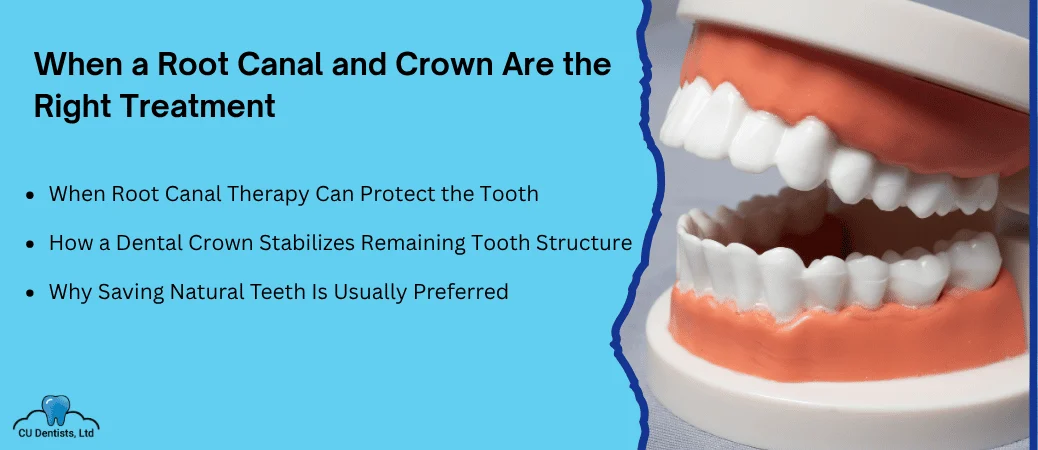
When Root Canal Therapy Can Protect the Tooth
A cracked tooth often lets bacteria reach the pulp, the soft tissue inside your tooth that holds nerves and blood vessels.
Once the pulp gets infected, it can cause pain, swelling, and even a bone infection if it’s left alone.
Root canal therapy removes that infected pulp and cleans out the space inside the tooth. This stops the infection from spreading and takes away the pain that comes with it.
Many patients are surprised to learn that a root canal with crown treatment is one of the most effective ways to save a tooth that might otherwise need to be pulled.
Once the inside of the tooth is cleaned and sealed, the outside still needs support. That’s where a crown comes in.
How a Dental Crown Stabilizes Remaining Tooth Structure
After a root canal, your tooth is hollowed out and weaker than it was before. You need a dental crown to cover the tooth like a cap, holding the remaining structure together so it doesn’t crack any further.
This matters most for back teeth like molars, since they handle the most force when you chew. A crown spreads that force evenly across the tooth instead of letting it press on one weak spot.
Crowns are shaped to match the size and function of your natural tooth. Once it’s in place, the restored tooth works the same way it did before, without shifting your bite or putting extra strain on the teeth next to it.
Why Saving Natural Teeth Is Usually Preferred
Keeping your natural teeth is usually better for your oral health than pulling them. Your jawbone needs the pressure from chewing to stay strong, and a natural tooth root supplies that pressure every day.
Remove the tooth, and the bone around it can start to shrink over time.
A root canal and crown may also mean fewer follow-up procedures than removing the tooth and replacing it later.
When a cracked molar can be restored, saving it can help maintain your natural bite and avoid the need for a replacement tooth.
At CU Dentists, preserving your natural tooth is considered whenever the tooth still has enough healthy structure to be restored.
Dr. R. Benjamin Scott can evaluate the depth and location of the crack and explain whether saving the molar or removing it is the more appropriate option for your situation.
When Extraction Is the Safer Choice
Sometimes a tooth just cannot be saved, no matter how hard your dentist tries. Here is what tips the scale toward pulling a tooth instead of fixing it, and what your options look like afterward.
Damage That Cannot Be Restored
If your tooth has a split tooth or a vertical root fracture, it usually cannot be fixed. A crack that runs down through the root lets bacteria in, and there is no way to seal it shut.
A split tooth means the crack goes all the way through, breaking the tooth into two pieces. Once this happens, the tooth loses its structure and cannot support a crown or filling.
Your dentist will check how deep and how long the crack is. If it reaches below the gum line or into the root, extraction becomes the only real choice left for you.
Infection, Root Involvement, and Bone Loss
A root fracture or deep decay can lead to infection that spreads into the bone around your tooth. When this happens, you might notice swelling, pain, or even a small bump on your gum that drains fluid.
Bone loss around a tooth is another red flag. If too much bone has worn away, the tooth cannot stay firmly in place, even with treatment.
Here are signs that point toward extraction rather than treatment:
- Infection keeps coming back after root canal treatment
- Bone loss is severe and spread out, not contained in one small area
- The tooth is loose and sinking into the socket
- A cracked tooth has already led to a draining abscess
Replacement Options After Tooth Extraction
Losing a tooth does not mean you have to live with a gap. Once your tooth extraction heals, you have a few solid choices for artificial teeth to fill the space.
| Option | What It Does |
| Dental implant | Replaces the root and tooth with a titanium post and crown |
| Bridge | Uses neighboring teeth to support a false tooth |
| Partial denture | A removable piece that fills one or more gaps |
Your dentist will often place a bone graft in the socket right after extraction. This step keeps the area strong and ready, so your new tooth has a solid base to sit on later.
Protecting the Rest of Your Smile After Treatment
Once you decide what happens to that cracked molar, the work isn’t over. Your bite, your other teeth, and the new dental work all need a bit of attention to stay healthy for the long run.

Managing Grinding and Heavy Bite Forces
If you grind your teeth at night, that habit likely played a role in cracking your molar in the first place. It won’t stop on its own just because you got treatment.
A night guard is one of the easiest ways to protect your remaining natural teeth from the same fate. It spreads out the bite force so no single tooth takes all the pressure.
You should also mention any jaw clenching or headaches to your dentist. These are often signs of a bite problem that’s putting stress on your teeth.
Catching this early can save you from another cracked tooth down the road.
Caring for a Crown or Replacement Tooth
Whether you got a dental crown or an implant to replace the tooth, it needs care just like your natural teeth. Brush and floss around it the same way you would anywhere else in your mouth.
Pay close attention to the edge where the crown meets your gum line. This spot can trap food and plaque if you’re not careful.
Avoid chewing ice, hard candy, or anything overly tough on that side of your mouth. Crowns are strong, but they aren’t indestructible. Regular checkups let your dentist spot small issues before they turn into bigger, costlier problems.
Knowing When New Pain Needs Prompt Dental Care
Some discomfort after treatment is normal, but certain signs mean you shouldn’t wait for your next scheduled visit.
Seek emergency dental services if you notice:
- Sharp pain when biting down
- Swelling in your gums or face
- A bad taste or smell near the treated tooth
- Pain that gets worse instead of better after a few days
These symptoms can point to infection, a loose crown, or a new crack forming. Acting fast keeps small problems from turning into bigger ones and helps protect your overall oral health.
Frequently Asked Questions
You probably still have a few questions rattling around after all that back-and-forth about your molar. Here are quick, straight answers to the questions people ask most about cracked teeth, treatment costs, and what comes next.
How do dentists decide whether a cracked molar can be saved?
Your dentist looks at where the crack is and how deep it goes. A crack that stays in the enamel is much easier to fix than one that reaches the nerve.
They also check if the crack runs up into the gum line or down into the root. This helps them figure out if a crown could save your tooth or if the damage is too far gone.
Your overall dental health matters too. If you have gum disease or a lot of decay nearby, your dentist may lean toward pulling the tooth instead of trying to save it, since natural teeth function best when the surrounding bone and gums are healthy.
What are the signs that a cracked tooth needs to be pulled?
A few warning signs point toward extraction instead of repair. Watch for these:
- Pain that gets worse over days instead of better
- A tooth that feels loose or wiggly
- Swollen or puffy gums around the tooth
- A crack you can see running below the gum line
- Signs of infection, like a bad taste or small bump on the gum
If your tooth shows several of these symptoms, it’s time to get it checked out soon. Waiting can make your options more limited.
Can a root canal and crown fix a cracked lower molar?
Yes, in many cases a root canal followed by a crown can save a cracked molar. This works best when the crack hasn’t split the tooth into separate pieces.
During the root canal, your dentist removes the damaged nerve tissue inside the tooth. Then a crown goes over the top to hold everything together and protect it from breaking further.
This combo tends to work well for cracks that reach the pulp but don’t go past the gum line. If the crack extends into the root itself, though, a root canal usually won’t be enough to save the tooth.
How much does it usually cost to save a cracked molar compared with extraction?
Saving a tooth with a root canal and crown almost always costs more upfront than pulling it. You’re paying for two separate procedures, plus the crown itself.
Extraction is cheaper right away, but it’s rarely the end of the story. Most people need a bridge, implant, or partial denture afterward to fill the gap, which adds cost later.
When you add up the full price of treatment over time, saving the tooth and replacing a missing one often land in a similar range. Your dentist can walk you through the exact numbers for your situation.
What happens if I wait too long to treat a cracked tooth?
Cracks don’t heal on their own, and they rarely stay the same size. A small crack today can turn into a bigger problem in just a few weeks if you ignore it.
The nerve inside your tooth can become inflamed and infected the longer a crack goes untreated.
This often leads to more pain, a possible abscess, and a much higher chance you’ll need extraction instead of a simple fix.
Cost tends to climb too. A minor crack that needs only bonding can turn into a case that requires a root canal, crown, or even extraction and an implant.
What are my replacement options if a lower molar has to be removed?
If your molar can’t be saved, you still have solid options to fill the gap. A dental implant is the most common choice, since it replaces both the tooth and its root.
A bridge is another option. It uses the teeth next to the gap to support a replacement tooth without needing surgery.
Removable partial dentures work too, especially if cost is a concern or you’re missing more than one tooth.
Whichever way you go, replacing a missing molar helps keep your bite even and stops nearby teeth from shifting out of place.
If the extraction itself turns out to be more involved, your dentist may refer you for a surgical procedure to remove the tooth safely, especially if the roots are curved or the tooth has broken below the gum line.