



You got a deep cleaning, followed the instructions, and your gums still bleed. That’s frustrating, and it’s more common than you might think.
Dentists move from scaling and root planing to oral surgery when pocket depths stay above about 5 millimeters after nonsurgical care, since deep pockets trap bacteria that instruments can’t fully reach.
The decision isn’t about how tough you are or how much you can afford. It comes down to measurable things like pocket depths, bone loss patterns, and disease severity.
Understanding scaling and root planing vs gum surgery can make it easier to see why your dentist may recommend one approach before moving to the other.
Below, you’ll see how dentists measure progress, when more nonsurgical treatment makes sense, what surgery actually does, and how to protect your gum health once treatment ends.
Key Takeaways
- A deep cleaning below the gumline doesn’t always resolve gum disease on its own.
- Dentists re-measure pocket depths and bone levels to decide the next step.
- Good home care and regular checkups keep periodontal treatment results from slipping.
Why Scaling and Root Planing May Not Be Enough
Deep cleaning works well for many people, but it has limits. Bacteria can stay hidden in deep pockets, and some gums never tighten back up the way your dentist hoped.
What Deep Cleaning Can and Cannot Treat
Scaling and root planing is a two-part job. Scaling removes plaque and hardened tartar (also called calculus), and root planing smooths the root surfaces below your gumline.
This works best for mild to moderate gum disease, usually when pockets measure about 4 to 6 millimeters deep.
Here’s what deep cleaning can’t do:
- Regrow lost bone around the tooth root
- Reach the bottom of very deep pockets, often 6 mm or more
- Fix bone craters or odd root shapes that trap bacteria
- Reverse gum recession that already happened
It’s also different from a routine cleaning that polishes healthy teeth at and just above the gumline. Knowing that difference helps you understand why one visit may not solve everything.
Persistent Infection Below the Gumline
Instruments have to reach the very bottom of a periodontal pocket to clear it out. In deep or narrow pockets, that’s hard to do, even for a skilled hygienist.
Molars are the usual troublemakers. They often have two or three roots with grooves and furcations where bacteria settle in and stay.
Signs the gum infection is still active include:
- Bleeding when your dentist checks the pocket
- Pus or a bad taste that keeps coming back
- Gums that stay puffy and red
- Ongoing bad breath
Some dentists add antibiotics, either placed right into the pocket or taken by mouth, to help.
If deep cleaning doesn’t fully work, the next step is usually a second look at the site rather than repeating the same treatment.
When Healing Does Not Reduce Pocket Depth
Your dentist will re-measure your pockets about four to six weeks after periodontal therapy. That follow-up visit is where the real decision gets made.
Healthy healing looks like this:
| Result at Re-Evaluation | What It Suggests |
| Pockets shrink to 3 mm or less, no bleeding | Move to regular maintenance visits |
| Pockets improve a little but still bleed | Retreat the area or try local antibiotics |
| Pockets stay 5 mm or deeper | Consider a referral for surgery |
When pockets stay deep, you can’t clean them at home and neither can your hygienist. That’s the point where flap surgery or pocket reduction gets discussed, since surgical options can reach areas that instruments alone cannot.
How Dentists Assess Ongoing Gum Disease
After a deep cleaning, your dentist doesn’t guess whether it worked. They re-measure your gums, compare new X-rays to older ones, and check how steady each tooth feels.
Periodontal Charting and Pocket Depth Measurement
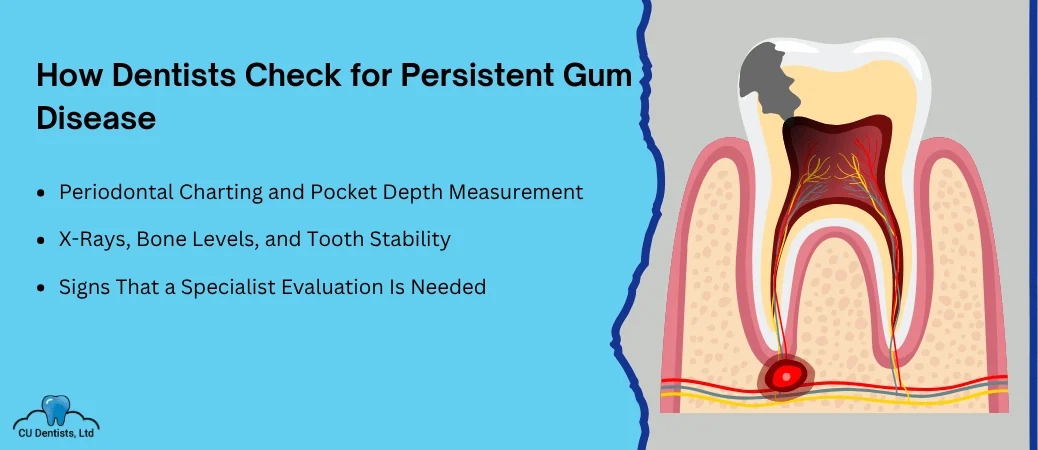
Your dentist or hygienist uses a small ruler called a probe to check the space between each tooth and your gum. This is pocket depth measurement, and it happens at six spots per tooth.
Your chart also records bleeding, gum recession, and pus. Bleeding when probed means gum inflammation is still active.
If your numbers went from 6 mm down to 4 mm, that’s progress. If they stayed the same or got deeper, your dentist looks at the next step in periodontal treatment.
X-Rays, Bone Levels, and Tooth Stability
Probing shows soft tissue. X-rays show what’s happening to the bone that holds your teeth in place.
Periodontitis destroys bone, and that loss doesn’t grow back on its own. Your dentist compares your current images to older ones to see if the bone loss stopped or kept moving.
They also test each tooth for movement. Mobility is graded from slight wiggle to a tooth that moves up and down in its socket.
Loose teeth, gum recession, and bone loss around one specific root often point to advanced periodontal disease in that area, even when the rest of your mouth looks fine.
Signs That a Specialist Evaluation Is Needed
A periodontist is a dentist with extra training in gum disease. Your dentist may refer you when the problem doesn’t respond to non-surgical care.
Watch for these signs:
- Pockets still 5 mm or deeper after healing time
- Bleeding gums at your follow-up visit
- Bad breath that keeps coming back
- Teeth that feel loose or have shifted
- Pus along the gumline
- Bone loss that’s still getting worse on X-rays
Timing matters here. Dental research links untreated periodontal disease to further attachment loss, so knowing what comes next when a deep cleaning doesn’t work protects your oral health and your remaining bone.
Choosing Between Additional Nonsurgical Care and Surgery
Once your gums have had time to heal after scaling and root planing, your dentist measures your pockets again and checks for bleeding.
Those numbers, along with your home care habits, point toward one of three paths: regular maintenance visits, another round of nonsurgical cleaning, or a referral for gum surgery.
When Periodontal Maintenance Is the Next Step
If most of your pockets shrank to 4 mm or less and they no longer bleed when probed, you’re in good shape. Your next step is periodontal maintenance rather than more treatment.
Maintenance visits usually happen every three to four months. They go a little deeper than a standard dental cleaning because your hygienist cleans below the gumline at sites that used to be infected.
Each visit includes fresh pocket measurements, so any backslide gets caught early.
Research on long-term periodontal outcomes shows that keeping inflammation under control with steady professional care and good brushing and flossing matters just as much as the original treatment did.
When Repeat Deep Cleaning May Be Considered
Sometimes a few spots stay stubborn at 4 to 5 mm with some bleeding. That doesn’t automatically mean surgery.
A second pass often works because the first one may have missed calculus hidden in grooves or on curved roots.
Your dentist is more likely to try again if:
- Only a handful of sites are still deep
- Your home care has clearly improved
- You quit smoking or got your blood sugar under better control
- The area is easy to reach with instruments
Repeat root planing is done with local anesthetic, just like the first time, and usually covers only the problem quadrant instead of your whole mouth.
When Gum Surgery Is Recommended
Pockets of 6 mm or deeper are the main trigger for a surgical referral. At that depth, instruments simply can’t reach the bottom of the pocket reliably, no matter how skilled the clinician is.
Flap surgery lifts the gum tissue back so the root surface can be cleaned directly, then the gum is stitched into place to fit more snugly.
Studies comparing methods found that access flap surgery reduces deep pockets more effectively than cleaning alone.
Other signs that point toward oral surgical treatment for advanced gum disease include bone loss around a tooth root, craters in the bone that trap bacteria, and pockets that keep bleeding after two rounds of nonsurgical care.
Bone grafting or regeneration may be added if there’s a defect worth rebuilding.
Your periodontist will explain the trade-offs first, since some procedures expose more root and can make teeth feel sensitive.
What Gum Surgery Can Address
When deep cleaning can’t reach every surface, surgery gives your periodontist direct access to the roots, the bone, and the tissue around each tooth.
That access makes it possible to shrink pockets, rebuild lost support, and decide which teeth are worth keeping.

Reducing Deep Pockets and Removing Hidden Deposits
Once a periodontal pocket passes about 5 or 6 millimeters, hand tools and ultrasonic scalers often can’t clean the bottom of it.
Flap surgery, also called pocket reduction surgery, solves that problem. Your periodontist makes small incisions along the gumline and folds the tissue back so the root surface is visible.
With the area open, they scrape away tartar and bacteria that were hidden below the gums, then stitch the tissue snugly back against the tooth.
The goal is a shallower pocket you can actually clean at home with a brush and floss.
This is the main difference between pocket reduction surgery and scaling and root planing: one works blind, the other works with a clear view.
Managing Bone Loss and Receding Gums
Advanced periodontal disease doesn’t stop at the gums. It eats away at the bone that holds your teeth in place.
Surgery can address that damage in a few ways:
- Bone grafting: Your own bone, donor bone, or a synthetic material fills the damaged area and acts as a scaffold while your body builds new bone.
- Guided tissue regeneration: A membrane keeps gum tissue from filling the space where bone belongs, giving the bone time to grow back.
- Gum grafting: Tissue, often taken from the roof of your mouth, covers roots exposed by gum recession.
Saving Teeth or Planning Tooth Replacement
Surgery is also a decision point. Your periodontist measures how much bone is left around each tooth before recommending anything.
Teeth with moderate bone loss and some remaining support are often worth saving through gum pocket treatment and regenerative procedures.
Loose teeth with severe bone loss are a different story. Keeping them can spread bacteria and cost you more bone.
In those cases, planned extraction followed by dental implants may protect your remaining permanent teeth better than holding on.
Your periodontist should walk you through both paths, including cost and healing time, before you choose.
Protecting Results After Treatment
Scaling, root planing, and gum surgery clean out what has already built up, but they don’t stop new plaque from forming tomorrow.
What you do at home, whether you smoke, and how often you return for checkups all shape whether your gum pockets stay shallow.
Daily Plaque Control at Home
Plaque starts rebuilding on your teeth within hours of a dental cleaning. Left alone, that soft film hardens into tartar below the gumline, where your toothbrush can’t reach.
Your daily routine matters more than any single appointment:
- Brush twice a day for two minutes with a soft-bristled brush, angled toward the gumline
- Clean between teeth once a day with floss, tiny brushes, or a water flosser
- Pay extra attention to back teeth, since premolars and molars have grooves and roots that trap bacteria
Good oral hygiene also lowers your risk of gingivitis coming back and helps prevent tooth decay.
That matters because deep decay can reach the pulp and lead to a root canal and crown, on top of your gum problems.
Smoking and Slower Gum Healing
Smoking is one of the strongest risk factors for gum disease, and it works against you after treatment too.
It reduces blood flow to your gums, which slows healing and makes it harder for tissue to reattach to the tooth root.
Smokers often see less pocket depth reduction after scaling and root planing than nonsmokers. Gum surgery outcomes can be less predictable as well.
Ask your dentist about quit-smoking support. Many practices can refer you to a program.
Keeping Follow-Up Visits and Understanding Coverage

Most patients need ongoing maintenance therapy to hold onto the gains from deep cleaning.
That usually means periodontal maintenance visits every three to four months instead of the standard six-month schedule.
These visits are different from a routine dental cleaning. Your hygienist re-measures pocket depths, cleans below the gumline, and flags any spots that are slipping backward.
Dental insurance often covers periodontal maintenance, but many plans limit how many visits they’ll pay for each year.
Ask the front desk to check your benefits before you book.
Frequently Asked Questions
Deep cleaning and gum surgery sound similar, but they treat different stages of gum disease, and the choice usually comes down to pocket depth, bleeding, and bone loss.
Below are straight answers about naming, decision-making, healing, your right to say no, and what these treatments tend to cost.
Is scaling and root planing the same as a deep cleaning?
Yes. “Deep cleaning” is the everyday name, and scaling and root planing is the clinical term.
A regular cleaning takes plaque and tartar off the visible parts of your teeth and a millimeter or two below the gumline.
Scaling and root planing goes deeper, into the pockets that form when gum tissue pulls away from the tooth.
Scaling removes the buildup. Root planing smooths the root surface so bacteria have a harder time sticking to it.
How do dentists decide whether I need scaling and root planing or gum surgery?
Your dentist measures the space between your gum and each tooth with a small probe. Those numbers, plus X-rays, drive the decision.
Deep cleaning is usually the first step when you have deep pockets, ongoing bleeding, or bone loss.
Surgery comes up later, when instruments can’t reach the bottom of a pocket or when bone needs to be rebuilt.
Very deep pockets, loose teeth, and infection that keeps coming back often mean a referral to a periodontal specialist.
Why didn’t my gums improve after a deep cleaning?
A few common reasons:
- Tartar was left behind in the deepest pockets or under the gum near a root curve.
- Home care slipped during the healing weeks, so bacteria built back up.
- Smoking or diabetes slowed healing.
- The disease was too advanced for cleaning alone to fix.
If your pockets are still deep at your recheck, the next steps after a deep cleaning may include repeat treatment in specific spots, antibacterial therapy, or a surgical option.
Can gums reattach to teeth after scaling and root planing?
Somewhat. Inflammation goes down, swelling shrinks, and pockets often get measurably shallower.
But gum tissue and bone that are already gone don’t grow back on their own.
That’s why people with a history of gum disease switch to periodontal maintenance visits, usually every three to four months instead of every six.
Is it ever okay to refuse scaling and root planing?
You can always ask questions before you agree to treatment. If scaling and root planing is recommended, ask your dentist to explain your pocket measurements, X-ray findings, and signs of active gum disease.
Reasonable questions: How many pockets are 4 mm or deeper? Do my X-rays show bone loss? What happens if we try a thorough regular cleaning and recheck in a few weeks?
If your pockets are mostly 1–3 mm with no bleeding, a regular cleaning may be enough. If they’re 5 mm or deeper with bleeding, delaying usually makes the problem harder to treat.
How much do scaling and root planing and gum surgery cost without insurance?
The cost of periodontal treatment depends on the severity of your gum disease, how many areas need treatment, and the type of procedure recommended.
Scaling and root planing is typically performed by sections of the mouth, while gum surgery may involve additional procedures such as bone grafting or tissue grafting.
Your dentist can provide a treatment plan that explains the recommended procedures and expected costs.
Reviewing these details before treatment can help you understand your options and plan for your care.