



Missing just one tooth can affect your smile, confidence, and ability to chew properly. While you have several options to replace that missing tooth, single tooth implants are typically the best choice when you have good oral health, sufficient jawbone density, and want a permanent solution that looks and feels natural.
Unlike bridges or dentures, single tooth implants provide a long-term solution that doesn’t affect your surrounding healthy teeth.
You might wonder if a single implant is worth the investment compared to other options like bridges or partial dentures. The answer depends on your specific situation, but implants offer unique benefits that make them ideal for many people.
They help preserve your jawbone, last for decades with proper care, and allow you to eat and speak normally without worry.
Understanding when single tooth implants work best will help you make the right decision for your smile. We’ll walk you through everything you need to know, from the procedure itself to costs and recovery, so you can decide if this treatment is right for your situation.
For a broader comparison, read our full guide on dental implants vs tooth bridges.
Understanding Single Tooth Implants
A single tooth implant replaces one missing tooth with a titanium post that fuses to your jawbone and supports an artificial crown. This treatment involves three main parts working together and differs from procedures that replace multiple teeth at once.
What Is a Single Tooth Implant?
A single tooth implant is a permanent solution that replaces one missing tooth in your mouth. Dental implants are small threaded posts that take the place of your natural tooth root.
The titanium post gets placed directly into your jawbone through a minor surgical procedure. Your bone grows around the implant over several months. This process creates a strong foundation for your replacement tooth.
Once an implant heals, you can use it just like a natural tooth. You can bite, chew, and smile with confidence. The implant looks and feels completely natural.
Single tooth implants work best when you have one missing tooth with healthy teeth on both sides. Your jawbone must also be strong enough to support the implant.
Components of a Single Tooth Implant
Your single-tooth implant has three separate parts that work together. Each part plays an important role in creating your new tooth.
The Implant Post The titanium post acts as your new tooth root. It measures about 3-4 millimeters wide and 10-15 millimeters long. Titanium bonds naturally with your jawbone through a process called osseointegration.
The Abutment This connector piece attaches to the top of your implant post. The abutment holds your crown in place. Your dentist screws it into the implant after your bone has healed completely.
The Crown Your custom-made crown looks exactly like your natural tooth. It gets cemented or screwed onto the abutment. The crown handles all your chewing and provides the visible part of your smile.
Single vs. Multiple Tooth Implants
Single tooth implants replace just one missing tooth without affecting your other teeth. Multiple tooth implants can replace several missing teeth using different approaches.
Single Tooth Benefits:
- Preserves healthy neighboring teeth
- Easier to clean and maintain
- Less expensive than multiple implants
- Shorter treatment time
Multiple Tooth Options: Implant-supported dentures attach to dental implants for people missing many teeth. You might need 2-4 implants to support a bridge that replaces 3-4 teeth.
Single implants work best when your missing tooth has healthy teeth on both sides. Multiple implant procedures make sense when you have several missing teeth in a row or throughout your mouth.
To better understand the post, abutment, and restoration, learn more about dental implant materials and how they affect long-term results.
When Is a Single Tooth Implant the Optimal Choice?
Single tooth implants work best when you have one missing tooth with healthy adjacent teeth and sufficient jawbone. Your oral health status and bone density play key roles in determining if this treatment will succeed.
Common Reasons for Recommending a Single Tooth Implant
Your dentist typically suggests a single tooth implant when you lose one tooth due to injury or decay. This happens often with front teeth after accidents or back molars that develop severe cavities.
A single implant protects your adjacent teeth better than other options. Bridges require grinding down healthy neighboring teeth. This damages the good tooth structure you want to keep.
Dental implants can replace one missing tooth without affecting surrounding teeth. The implant stands alone in your jawbone.
Key situations include:
- Sports injuries that knock out a single tooth
- Failed root canal treatments
- Severe tooth decay that requires extraction
- Congenital missing teeth (born without certain teeth)
Your missing tooth location matters too. Front teeth need immediate replacement for appearance. Back teeth need replacement to maintain proper chewing function.
Ideal Candidate Profiles
You make a good candidate if you have sufficient jawbone and healthy gums. Your overall dental health affects implant success rates significantly.
Good candidates typically have:
- Adequate bone density in the jaw
- Healthy gum tissue
- Good oral hygiene habits
- No uncontrolled diabetes or gum disease
Age rarely prevents implant placement. Dental implants work effectively for seniors when bone and gum health allow it.
You need realistic expectations about healing time. The process takes several months from start to finish.
Non-smokers heal better than smokers. Tobacco use increases complications and failure rates. Your dentist may ask you to quit smoking before treatment.
Importance of Jawbone Health
Your jawbone must be strong enough to support the implant. The bone fuses with the titanium implant during healing. This process is called osseointegration.
Insufficient bone density leads to implant failure. Your jawbone naturally shrinks after tooth loss. Missing teeth cause additional bone loss over time if not replaced.
Bone health factors include:
- Bone density measurements
- Time since tooth extraction
- Previous infections or trauma
- Medical conditions affecting bone
Your dentist takes X-rays or CT scans to check bone quality. Some patients need bone grafts before implant placement. These procedures add time but improve success rates.
A healthy jawbone provides the foundation for long-term implant stability. Without adequate bone, the implant cannot integrate properly.
Role of Adjacent Teeth in Treatment Decisions
Your neighboring teeth greatly influence treatment planning. Healthy adjacent teeth make single implants the preferred choice over bridges or partial dentures.
Bridges connect to adjacent teeth for support. This requires removing healthy tooth structure from neighboring teeth. Single implants preserve these teeth completely.
Adjacent tooth considerations:
- Current health status
- Previous dental work present
- Spacing between teeth
- Bite alignment issues
Crowded or widely spaced teeth may complicate implant placement. Your dentist evaluates the gap size and available space. Proper spacing ensures good oral hygiene around the implant.
Strong adjacent teeth indicate good oral health habits. This suggests you will maintain the implant properly long-term. Weak or damaged neighboring teeth might require treatment first.
Your bite pattern affects implant success. Heavy grinding or clenching can stress implants. Your dentist may recommend a night guard for protection.
Don’t let one missing tooth affect your confidence. Book your single tooth implant appointment today with our Champaign implant specialists for a long-lasting solution.
Comparing Single Tooth Implants With Other Tooth Replacement Options
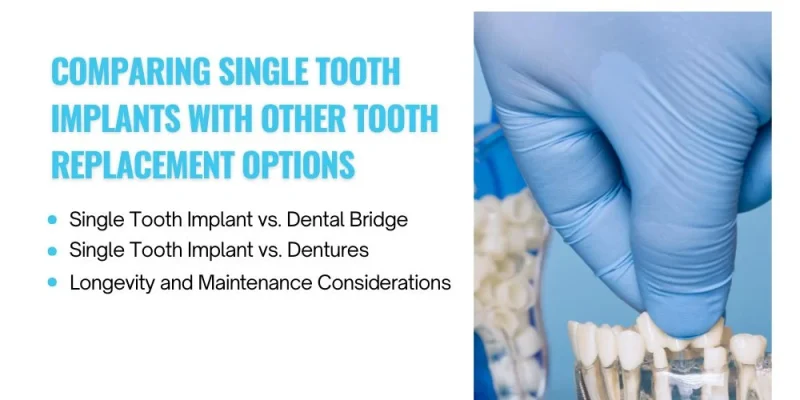
When you lose a single tooth, you have three main tooth replacement options to consider. Each option differs in cost, durability, and how it affects your other teeth.
Single Tooth Implant vs. Dental Bridge
Dental bridges cost less upfront but are less durable than implants. A bridge connects crowns to your healthy teeth on both sides of the gap. This means your dentist must grind down two healthy teeth to place the bridge.
Single-tooth implants replace just the missing tooth without touching your healthy teeth. The implant goes directly into your jawbone like a natural tooth root.
Key differences include:
- Cost: Bridges cost less initially but may need replacement sooner
- Healthy teeth: Bridges require altering adjacent teeth; implants don’t
- Installation time: Bridges take 2-3 weeks; implants take 3-6 months
- Insurance: Bridges get better insurance coverage
Bridges can be harder to keep clean because you can’t floss between the connected teeth normally. You’ll need special floss threaders or water flossers for proper oral hygiene.
Single Tooth Implant vs. Dentures
Partial dentures can replace a single missing tooth, but they’re removable and less stable. They clip onto your existing teeth and can move when you eat or speak.
Single tooth implants stay fixed in place and feel more like your natural teeth. You brush and floss them just like regular teeth.
Main differences:
- Stability: Implants don’t move; partial dentures can shift
- Natural look and feel: Implants feel more like real teeth
- Daily care: Implants need regular brushing; dentures require removal for cleaning
- Bone health: Implants help preserve jawbone; dentures don’t
Dental implants typically cost more than dentures but can last a lifetime with proper care. Partial dentures usually need replacement every 5-8 years.
Longevity and Maintenance Considerations
Single tooth implants offer the best longevity of all tooth replacement options. The implant itself can last your entire lifetime. The crown on top typically needs replacement every 15-20 years.
Dental bridges have a shorter lifespan, often needing replacement after 5-7 years. This happens because bacteria can get under the bridge or the supporting teeth can develop problems.
Maintenance requirements:
- Implants: Regular brushing, flossing, and dental checkups
- Bridges: Special cleaning tools and careful oral hygiene
- Partial dentures: Daily removal, soaking, and special cleaning
Your daily oral hygiene routine affects how long each option lasts. Implants are easiest to maintain because you clean them like natural teeth. Bridges require extra steps and tools to clean properly underneath.
The Single Tooth Implant Procedure: Step by Step
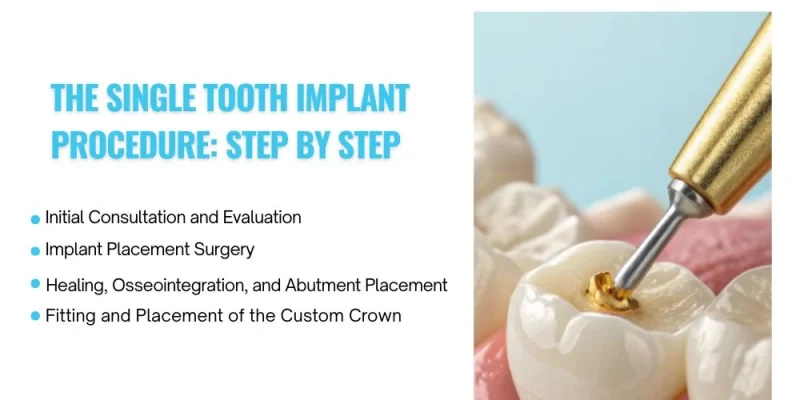
Getting a single tooth implant involves four main steps that happen over several months. Your implant dentist will place a titanium post in your jawbone, let it heal, then attach your new tooth.
Initial Consultation and Evaluation
Your implant dentist will start by examining your mouth and taking X-rays. These images show the health of your jawbone and surrounding teeth.
You’ll discuss your medical history and any medications you take. Some health conditions can affect healing after implant surgery.
Key tests include:
- Digital X-rays or CT scans
- Gum health assessment
- Bite analysis
- Bone density evaluation
Your dentist will measure the space where your missing tooth was. This helps them plan the exact size and position for your titanium post.
If your jawbone isn’t thick enough, you might need a bone graft first. This adds extra bone material to create a strong foundation for your implant.
The dentist will create a treatment plan just for you. They’ll explain each step and answer your questions about the process.
Implant Placement Surgery
Implant placement surgery happens in your dentist’s office using local anesthesia. You’ll feel pressure but no pain during the procedure.
Your dentist makes a small cut in your gum to reach the jawbone. They use special tools to create a precise hole in the bone.
The titanium post gets screwed into this hole. Your dentist positions it carefully to match your natural tooth root.
Surgery steps:
- Numb the area with local anesthesia
- Make a small gum incision
- Drill a hole in the jawbone
- Insert the titanium post
- Close the gum with stitches
The whole surgery takes about 1-2 hours. You can go home the same day with care instructions.
Some swelling and mild discomfort is normal for a few days. Your dentist will give you pain medication and antibiotics if needed.
Healing, Osseointegration, and Abutment Placement
Osseointegration is when your jawbone grows around and bonds with the titanium post. This process takes 3-6 months.
During healing, eat soft foods and avoid chewing on the implant side. Keep the area clean but brush gently around the surgical site.
Your dentist will check your progress with follow-up visits. They’ll make sure the implant is healing properly and the gum looks healthy.
Healing timeline:
- First week: Swelling and tenderness
- 2-4 weeks: Gum tissue heals
- 3-6 months: Bone bonds with implant
Once osseointegration is complete, you’ll return for abutment placement. The abutment is a small connector piece that attaches to your implant.
Your dentist reopens the gum and screws the abutment onto the titanium post. This piece will hold your final crown in place.
Fitting and Placement of the Custom Crown
Your dentist takes impressions of your teeth to create your custom crown. This ensures it matches your other teeth perfectly in size, shape, and color.
A dental lab makes your crown from strong materials like porcelain or ceramic. The process usually takes 1-2 weeks.
During a fitting appointment, your dentist checks how the crown fits and looks. They make sure it doesn’t interfere with your bite.
Crown placement involves:
- Testing the fit and appearance
- Checking your bite alignment
- Making final adjustments
- Permanently attaching the crown
The crown gets cemented or screwed onto the abutment. Your dentist will show you how to care for your new tooth properly.
Your single tooth implant now looks and functions just like your natural teeth. With good care, it can last for decades.
Your perfect smile begins with one step. Visit CU Dentists in Champaign to learn how our precise, step-by-step implant process restores your tooth for life.
Risks, Challenges, and Special Considerations
Single tooth implants carry specific risks that you should understand before treatment. Infection, bone problems, and gum health issues can affect your implant’s success and require careful attention throughout the healing process.
Potential Complications and How to Prevent Them
Dental implant surgery poses some health risks, though these problems are usually small and easily treated when they happen.
Infection is the most common early complication. You might notice increased pain, swelling, or discharge around your implant site. Taking prescribed antibiotics and keeping the area clean helps prevent this problem.
Nerve damage can cause numbness or tingling in your teeth, gums, lips, or chin. This happens when the implant is placed too close to a nerve. Your dentist uses X-rays and 3D scans to avoid this issue.
Damage to nearby structures like blood vessels or adjacent teeth can occur during surgery. Choosing an experienced surgeon reduces this risk significantly.
Sinus problems may develop if upper jaw implants poke into your sinus cavities. Your dentist will check your sinus location before surgery to prevent this complication.
Bone Loss and Bone Grafting
Your jawbone needs enough thickness and density to support a single tooth implant. Without adequate bone, your implant will likely fail.
Bone grafting becomes necessary when your jawbone is too thin or soft. Your dentist can use natural bone from your body, synthetic materials, or donor bone to rebuild your jaw.
The bone graft process adds several months to your treatment time. You need to wait for the transplanted bone to grow and strengthen before implant placement.
Minor bone grafting can sometimes happen during the same appointment as your implant surgery. More extensive grafting requires a separate procedure and longer healing time.
Your age, overall health, and how long you’ve been missing the tooth all affect your bone density. The sooner you get an implant after tooth loss, the better your bone condition will be.
Impact of Gum Disease and Oral Hygiene
Gum disease is one of the biggest threats to implant success. Active gum disease must be treated completely before you can receive an implant.
Bacteria from gum disease can cause peri-implantitis, which is like gum disease around your implant. This condition can destroy the bone supporting your implant and cause it to fail.
Your oral hygiene habits directly affect your implant’s long-term success. You need to brush twice daily, floss regularly, and use special brushes to clean around the implant.
Regular dental visits become even more important with an implant. Your dentist needs to monitor your gum health and catch any problems early.
Smoking significantly increases your risk of implant failure and gum disease. If you smoke, quitting before and after surgery greatly improves your chances of success.
Poor dental health habits that led to your original tooth loss will also threaten your new implant. Developing better oral hygiene practices is essential for long-term success.
What to Expect: Results, Costs, and Long-Term Care
Single tooth implants offer excellent results with proper planning and care. The investment varies based on several factors, but most patients enjoy decades of natural function with basic maintenance.
Natural Look and Feel After Treatment
Your single tooth implant will look and feel completely natural once the healing process is complete. The custom crown matches your existing teeth in color, shape, and size.
You can eat all your favorite foods without worry. The implant functions just like your natural tooth root, giving you full chewing power.
Most people cannot tell the difference between your implant and natural teeth. Your friends and family won’t notice anything unusual about your smile.
The implant feels secure and stable in your mouth. Unlike removable options, you never have to worry about it shifting or falling out when you talk or laugh.
Cost Factors and Insurance Considerations
Single tooth implants typically cost between $3,000 and $5,000 per tooth. This includes the implant, abutment, and crown.
Several factors affect your total cost:
- Location of the missing tooth – Front teeth may cost more due to aesthetic requirements
- Bone grafting needs – Additional procedures increase the price
- Geographic location – Prices vary by region and city
- Dentist experience – Specialists often charge higher fees
Many dental insurance plans cover 50% of implant costs. Check with your insurance company about coverage limits and waiting periods.
Some dental offices offer payment plans or financing options. This helps you spread the cost over several months or years.
Longevity and Daily Care Tips
Dental implants can last a lifetime with proper care. Most implants have success rates above 95% after 10 years.
Your daily oral hygiene routine stays the same. Brush twice daily with fluoride toothpaste and floss around the implant crown.
Essential care tips:
- Use a soft-bristled toothbrush
- Clean around the implant gently
- Visit your dentist every six months
- Avoid chewing ice or hard objects
Professional cleanings help prevent gum disease around your implant. Your dental team will check the implant and surrounding tissues during regular visits.
Stop smoking if you currently smoke. Smoking increases the risk of implant failure and slows healing after surgery.
Frequently Asked Questions
How do you determine if I’m a good candidate for a single tooth implant?
Your dentist will check if your jawbone is strong enough to support an implant. You need healthy gums and enough bone density where the missing tooth was located.
Dental implants are considered safe for many people, but some conditions may affect your eligibility. Your age, overall health, and oral hygiene habits all play a role in determining if you’re a good fit.
Certain medical conditions like uncontrolled diabetes or heavy smoking can affect healing. Your dentist may recommend bone grafting if your jawbone isn’t thick enough to hold the implant securely.
What can I expect during the single tooth implant procedure?
During dental implant surgery, your surgeon will give you anesthesia to numb your gums. The procedure typically takes one to two hours for a single tooth.
Your surgeon makes a small cut in your gum to expose the jawbone. They create a precise hole in the bone and carefully place the titanium implant post.
After placing the implant, your surgeon closes the incision with stitches. If the implant is in the front of your mouth, you may receive a temporary tooth to wear during healing.
How long does it take to recover from a single tooth implant surgery?
The initial healing period lasts about one to two weeks. During this time, you may experience mild swelling and discomfort that over-the-counter pain medications can manage.
The healing phase called osseointegration can take anywhere from three to nine months. This is when your jawbone fuses with the implant to create a strong foundation.
Once osseointegration is complete, your dentist attaches the abutment and final crown. This appointment usually takes about one hour and may require minor surgery.
What are the advantages of choosing a single tooth implant over other tooth replacement options?
Dental implants are the closest thing to natural teeth and last longer than any other replacement option. They don’t affect your neighboring healthy teeth like bridges do.
Single tooth implants allow you to brush and floss normally. Unlike partial dentures, they won’t slip or move when you eat or speak.
Implants help preserve your jawbone by providing the stimulation that natural tooth roots give. This prevents the bone loss that often happens after tooth extraction.
Can you explain the difference between full arch and single tooth implants?
Single tooth implants replace one missing tooth with one implant post and crown. Full arch implants replace an entire upper or lower set of teeth using four to six implant posts.
Dental implants are an option when you need to replace a single tooth or when you’re missing several teeth. The number of missing teeth determines which approach works best.
Full arch implants support a complete set of fixed teeth on fewer implant posts. Single tooth implants give you individual replacement teeth that function independently.
How does the cost of a single tooth implant compare to other dental restoration methods?
Single tooth implants typically cost more upfront than bridges or partial dentures. However, dental implants last longer and are easier to clean than bridges.
The initial investment in an implant often pays off over time because implants can last 25 years or more with proper care. Bridges usually need replacement every 10 to 15 years.
Choosing the right solution depends on factors such as price, preference, and the health of your jawbone. Your dentist can help you compare the long-term costs of each option.