




Dental implant cost trends in the US vs Champaign IL, show that while implants remain one of the most effective solutions for replacing missing teeth, affordability continues to be a major consideration for many patients.
Dental implants use titanium posts to replace tooth roots and support natural-looking crowns. Across the United States, implant use has grown rapidly as the population ages and technology advances.
However, implants are still largely paid out-of-pocket because Medicare and most Medicaid programs do not cover them.
National Health and Nutrition Examination Survey (NHANES) data show implant prevalence among older adults increased from about 1% in the early 2000s to roughly 8% by 2020.
Market reports also highlight strong growth, with the U.S. dental implant market increasing from approximately $1.3 billion in 2020 to $3.0 billion in 2023 and projected to continue expanding through 2030.
High Success Rates, Few Access Barriers Themselves
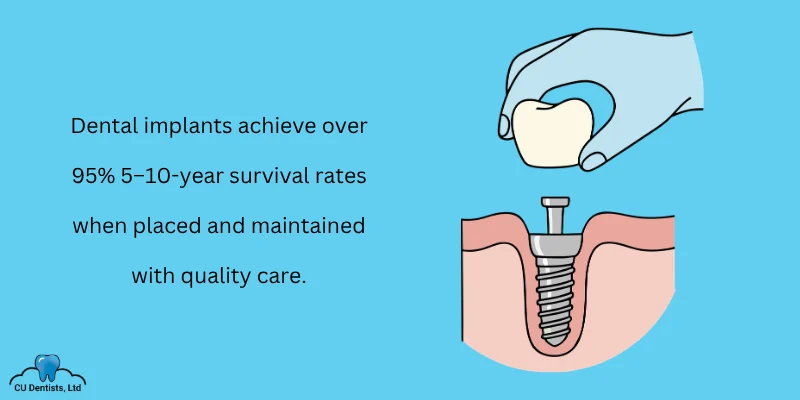
Dental implants have very high success and survival rates. Meta-analyses find 5–10 year survival well above 95% in U.S. studies.
In practice, few clinics stratify outcomes by urban/rural location; existing evidence suggests no intrinsic disadvantage to rural patients if they get similar care.
For example, a recent Chinese rural cohort saw zero implant failures over 1–2 years, indicating that when qualified providers perform the procedure, results match national benchmarks.
Thus, the limiting factor is not technology per se but access to providers and follow-up care.
Rural patients often face longer travel distances and fewer specialists (oral surgeons, periodontists), which may delay treatment or maintenance.
Nonetheless, with high-quality surgical care and maintenance, long-term outcomes should be excellent everywhere.
U.S. Costs and Coverage
A major barrier to implant access is cost. A complete single-tooth implant (fixture, abutment, crown) often costs \$3,000–\$6,000 in the U.S., with full-arch or multiple-tooth cases proportionally higher.
(Estimates vary: one guide reports an average implant fixture alone at \$2,100, range \$1,600–\$4,100, excluding the crown; another cites \$2,143 average, \$1,646–\$4,157 range.)
Because implants are classified as elective or prosthetic, they are not covered by Medicare. Original Medicare Parts A/B explicitly exclude routine dental (cleanings, extractions, dentures, implants).
Some Medicare Advantage plans offer limited dental benefits, but they rarely cover high-cost implants. Similarly, most state Medicaid programs do not cover dental implants for adults.
In Illinois, for example, Medicaid generally excluded implants except in rare medically-necessary cases. (Even when medically needed, Medicaid requires extensive prior authorization and documentation.)
Thus, seniors and low-income patients face full out-of-pocket expenses, unless they carry dental insurance riders or seek charitable programs.
Consequently, implant procedures often require patient financing or savings. Third-party financing (Dental credit plans) and discount clinics can help, but do not change the underlying fact that implants are a major cost.
Community surveys reflect this: in Champaign County, over one-quarter of adults reported difficulty affording dental care.
Nationally, studies show pronounced disparities in implant receipt: non-Hispanic Black and impoverished adults are much less likely to have implants than White or higher-income peers.
This confirms that affordability, more than medical need, largely drives who can get implants.
Provider Workforce and Access
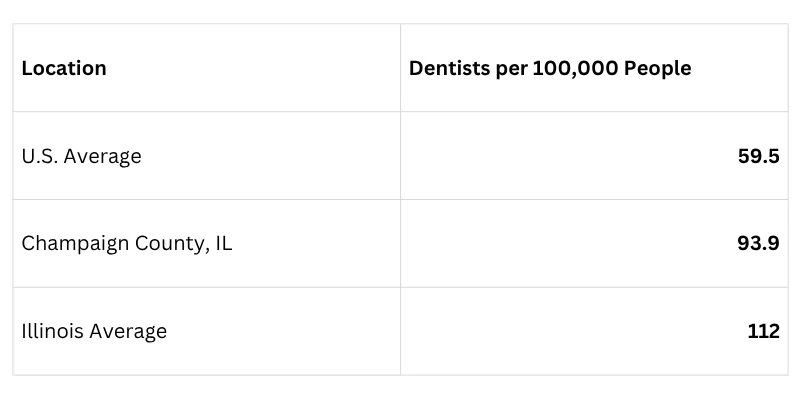
Access also depends on provider availability. Nationally, there are about 59.5 dentists per 100,000 people (2024 data).
Specialists who perform implants (oral surgeons, periodontists, prosthodontists) are a smaller subset.
Dentist density varies widely by region. In Champaign County, recent data suggest roughly 93.9 dentists per 100,000 population.
This is actually above the U.S. average (59.5) but slightly below the Illinois average (112), reflecting the presence of the University of Illinois College of Dentistry training center in Urbana-Champaign.
In other parts of Illinois, 75 of 102 counties are designated Dental Health Professional Shortage Areas.
Champaign city itself is not shortage-designated, whereas nearby rural towns (e.g. Rantoul, pop. 12K) have far fewer local providers. In practice, many rural residents travel to Champaign-Urbana for specialized implant services.
Champaign County Profile
Champaign County (pop.~210,000) has a young median age (30.7 years) due to the large university and college student population. The racial/ethnic mix is about 62% White, 13% Black, 11% Asian (many university-affiliated), plus others.
The median household income is roughly \$63,700 (per capita \$52,019), but poverty is relatively high: about 19% of residents live below the poverty line, versus ~12.5% nationally.
(Much of the poverty reflects students on limited incomes.) These demographics influence implant access: many county residents lack savings or insurance for expensive treatments.
According to state health surveys, about 73.7% of Champaign County adults report having any dental insurance coverage, leaving roughly 26% uninsured.
This insurance figure is somewhat higher than in some rural Illinois counties, but still means a quarter of adults pay entirely out-of-pocket for dental care.
Reflecting these challenges, community health data indicate around 66% of Champaign adults saw a dentist in the past year (near national average), but ~25–30% reported difficulty accessing affordable care.
In the 2021–23 Champaign County Community Health Plan survey, roughly 15% were dissatisfied with dental care quality and over 25% with its affordability/accessibility.
These local statistics underscore that, even in an urban county, cost and availability are significant obstacles for many.
Within the county, low-income and uninsured groups are most affected. Illinois Medicaid does cover routine restorations (fillings, dentures) but typically excludes implants.
(As noted, only rare medical-necessity exceptions apply.) Consequently, eligible Medicaid recipients and many privately insured seniors lack any benefit for implants.
Some nonprofit clinics and university dental programs in Champaign offer low-cost dentures or extractions, but not implants.
Recently, local initiatives like mobile dental clinics and sliding-scale services have expanded preventive and basic restorative care.
These improve overall oral health, which can reduce future implant needs by preventing tooth loss, but they do not directly reduce implant costs.
Comparison: U.S. vs Champaign
Implant Prevalence: No precise implant utilization rate is reported for Champaign County.
However, based on national models, it likely mirrors Illinois trends: low single-digit percentages overall, rising among older subgroups.
The county’s younger demographics mean fewer seniors (who have highest implant uptake) than in many areas.
Unlike the nation as a whole (where only ~8% of 50+ adults had implants by 2020), Champaign’s implant users are more likely to be older, insured residents.
Urban Champaign probably has higher implant rates than rural Illinois, but many residents (especially low-income) are still left out.
Provider Access: Champaign County is relatively well served. Its ~94 dentists/100k people outpaces the U.S. average of ~60/100k.
The presence of an academic dental school means access to specialists (periodontists, surgeons) is much better than in a typical rural county.
Nationally, many rural U.S. counties have few or no specialists, whereas Champaign has multiple practitioners able to perform implants.
This urban-rural gap exists nationwide, and it is reflected locally: Champaign’s urban core provides implants routinely, while rural residents must travel in.
Affordability: Both nationally and in Champaign, the big affordability gap is similar.
U.S. median income (~\$75k in 2024) is higher than Champaign’s \$63k, but Champaign’s poverty rate (19%) is above national (~12.5%).
Thus, Champaign has a larger share of lower-income households that depend on insurance for dental implants. Without insurance coverage, even middle-income patients may delay implants due to cost: national surveys and
Champaign community assessments both report that a significant minority skip needed dental care for financial reasons. In Champaign specifically, about 1 in 4 adults cited affordability as a barrier.
This is comparable to national findings that implant recipients skew higher-income.
Policy/Insurance: The policy environment is essentially the same in Champaign as the national scene.
Medicare’s exclusion of implants applies to all, and Illinois Medicaid’s no-implant rule affects low-income county residents as in other states.
However, because Champaign has a higher insured rate (74% vs a U.S. average of ~65–70% with dental coverage), one might expect slightly better access. In practice, Champaign’s advantage comes from Medicaid for children and employer plans – but these still usually exclude implants or cap benefits.
Many local employers offer dental insurance, but typically only cover crowns, bridges or dentures (not implants).
Utilization and Gaps: The combination of good provider density but notable cost barriers means Champaign reflects a microcosm of U.S. trends.
Those who “opt in” are usually better resourced: older seniors with Medicare Advantage or dental riders, or patients with generous employer plans or Personal Savings.
Low-income and uninsured residents (nearly 20% of Champaign) have limited implant access, similar to the roughly one-quarter of U.S. adults who lacked dental coverage before 2020. In both U.S. and Champaign, educational outreach and financing (e.g. CareCredit, philanthropic programs) have tried to fill gaps, but demand still outstrips affordable supply.
Summary and Outlook
In summary, dental implant use in the U.S. has expanded rapidly in recent years, driven by an aging population and better technology, but adoption remains concentrated in affluent, insured groups.
Costs are high (\$2–6k per tooth), and Medicare/Medicaid provide virtually no coverage.
Champaign County largely follows these national patterns. It enjoys strong provider availability (near 94 dentists/100k) and a high rate of annual dental visits, but it also has above-average poverty (19%) and a substantial uninsured share.
Local data show about 25–30% of residents struggle to afford dental care, indicating many potential implant candidates are deferred.
Looking ahead, experts forecast continued growth: implant prevalence among U.S. adults could approach 20–23% by 2026.
To translate this into Champaign context would mean more seniors receiving implants, but only if cost barriers are addressed.
Possible remedies include expanded insurance coverage (some states are considering adding limited adult dental benefits to Medicaid) and innovative payment models.
In the meantime, Champaign’s mixed urban/rural landscape underscores that access improvements (e.g. mobile clinics, specialist outreach to surrounding communities) are as important as subsidies.
Key Takeaways:
- Prevalence rising: U.S. implant prevalence climbed 0.7%→5.7% (1999–2016) and 1.3%→8.4% (1999–2020, age 50+). Projections suggest ~20% prevalence by 2026.
- High success rates: Implants show >95% long-term survival across settings; rural patients who receive implants do just as well if quality care is provided.
- Cost barriers: Single-tooth implants cost several thousand dollars. Original Medicare and most Medicaid plans exclude implants, so patients usually pay OOP.
- Disparities: Nationally, implant use is concentrated among older, wealthier, insured, and non-Hispanic White populations. Similar patterns likely hold in Champaign County.Community surveys in Champaign show ~25–30% of residents cite cost/access issues with dental care.
- Provider access: Champaign County (~94 dentists/100k) has much higher provider density than many rural areas. This should facilitate implant access for urban residents, but rural neighbors still face shortages.
- Implications: Improving implant access requires addressing affordability (insurance reforms, sliding-scale programs) and expanding delivery (tele-dentistry consultations, mobile surgery units, etc.).Ongoing public health efforts in Champaign (mobile clinics, expanded preventive care) aim to reduce overall tooth loss and eventually make implants feasible for more people.
Sources: Data from national surveys and journals (NHANES, JADA) and Champaign-area public health reports were synthesized.
Key references include Dye et al. (JADA 2024) for U.S. implant trends, Illinois public health data, ADA workforce statistics, and local Champaign community health assessments.
These highlight the clear gap between implant technology and broad affordability/access on both national and local levels.
References:
- Does Medicare Cover Dental Implants? | Humana
- Dental Implant Failure Trends U.S. | National Data & Risk Factors
- Implant and implant restoration trends among adults 50 years and older in the United States, National Health and Nutrition Examination Survey 1999-2020 – ScienceDirect
- Dental Implant Adoption Trends in the U.S. Market Insights
- Dental Implant Success Urban vs. Rural Study: Key Insights
- Single Tooth Dental Implants Cost and Procedure Guide
- Dentist Workforce | American Dental Association
- Champaign County, Illinois Population 2026
- Champaign County, IL | Data USA
- Oral Health PM_Data Tables (Printable).xlsx