



Dental implants can replace missing teeth and restore your smile, but the price tag often catches people off guard. The total cost of a dental implant typically runs between $3,000 and $4,500 per tooth, while a full mouth of implants can range from $60,000 to $90,000.
These numbers might seem high, but understanding what goes into the cost can help you plan better and find ways to make treatment more affordable.
The price you pay depends on several factors, from where you live to how complex your case is. Some people need just one implant, while others need multiple teeth replaced or require extra procedures like bone grafts.
The good news is that dental insurance coverage for implants is improving, and you have options to spread out the payments over time.
This guide breaks down everything you need to know about dental implant costs in 2026. You’ll learn what affects the price, how implants compare to other options like bridges and dentures, and practical ways to reduce your out-of-pocket expenses.
Key Takeaways
- Single dental implants cost between $3,100 and $5,800 including the implant, abutment, and crown
- Insurance companies now typically reimburse about $1,500 per implant per year, and many dentists offer payment plans
- The final price varies based on your location, the complexity of your case, and whether you need additional procedures like bone grafts
Schedule your dental implant cost consultation in Champaign, IL with CU Dentist.
How Much Do Dental Implants Cost?
The cost of dental implants varies widely based on the number of teeth you need to replace and the complexity of your case. A single tooth replacement costs much less than full-mouth implants, and your final price depends on factors like additional procedures and your location.
Average Price Ranges for Dental Implants
The cost for an individual dental implant ranges from $2,800 to $5,600 without dental benefits. Your total expense includes multiple components that make up the final dental implants price.
The elements that affect your cost include a comprehensive dental exam with 3D imaging, extraction of problem teeth if needed, installation of the dental implant itself, placement of the abutment hardware, fabrication of the dental crown, and placement of the crown. Each part has its own separate fee.
Key cost factors include:
- Your geographic location and local market rates
- The experience level of your dental provider
- Whether you need preliminary procedures like bone grafts
- The type of materials used for your implants and crowns
Large metropolitan areas tend to have higher prices than smaller cities. The complexity of your specific case also plays a major role in determining your final dental implant cost.
Single Dental Implant Cost Breakdown
A single dental implant typically costs between $3,000 and $4,500 from start to finish. This price includes the implant screw that goes into your jawbone, the abutment that connects to it, and the crown that replaces your visible tooth.
You might need additional procedures that add to your cost. Many patients require a sinus lift or bone graft to make the jawbone strong enough to hold the implant stable. The total cost of an implant, abutment, crown and other necessary procedures ranges from $3,100 to $5,800 based on industry surveys.
If you need a 3D CT scan during your initial exam, you could pay between $350 and $515 for that service alone. Some dental practices offer this imaging for free as an incentive to new patients. You should ask your dentist for a complete cost breakdown before starting treatment so you understand exactly what you’ll pay.
Full Mouth Dental Implants Cost
Full mouth dental implants cost between $24,000 and $90,000 depending on which approach you choose. The most expensive option is replacing each tooth individually, which typically runs $60,000 to $90,000 for your entire mouth.
A more affordable choice is implant-supported dentures, where two full arches of false teeth replace all your natural upper and lower teeth. Each arch attaches to four to six implants in your jaw. This option, also known by the trademarked name All-on-4, typically ranges from $24,000 to $50,000 for a complete set.
Full mouth options include:
| Option | Price Range | Number of Implants |
| Individual tooth replacement | $60,000 – $90,000 | One per tooth |
| All-on-4 dentures | $24,000 – $50,000 | 4-6 per arch |
The individual replacement method is more comfortable and allows your dentist to save any healthy existing teeth. The All-on-4 approach costs less but requires removing all remaining teeth in the treated arch.
Book a dental implant pricing visit in Rantoul, IL and get a clear treatment plan.
What Determines the Cost of Dental Implants?
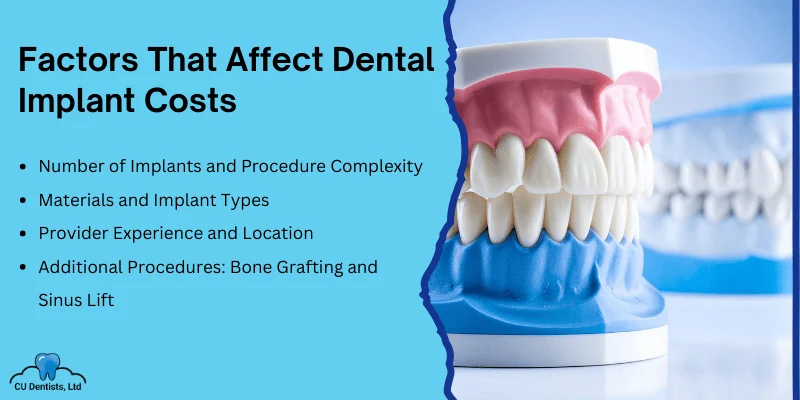
Several factors affect how much you’ll pay for dental implants. The number of teeth you need to replace, the materials your dentist uses, where you live, and whether you need extra procedures all play a role in your final bill.
Number of Implants and Procedure Complexity
The number of teeth you need to replace directly impacts your total cost. A single implant typically includes the implant post, abutment, and dental crown. The cost for one complete tooth replacement ranges from $3,000 to $5,800.
If you’re missing several teeth next to each other, you might need fewer implants than you think. A bridge supported by two implants can replace three or four adjacent teeth for around $6,000 to $10,000. This approach costs less than getting individual implants for each missing tooth.
Full-mouth replacements offer different options based on complexity. Individual implants for all your teeth are the most expensive choice at $60,000 to $90,000. Implant-supported dentures, which use four to six implants per arch, cost between $24,000 and $50,000 for both upper and lower teeth.
Your specific dental situation also affects pricing. If you have healthy jawbone and gums, the procedure stays straightforward. Complex cases that need extra work take more time and increase costs.
Materials and Implant Types
The materials used for your implant post, abutment, and crown influence the price. Most implants use titanium or ceramic for the post that goes into your jawbone. These materials vary in cost based on quality and brand.
Your dental crown also comes in different materials. Porcelain crowns look natural but cost more than other options. Metal crowns are stronger and less expensive but more visible. Porcelain-fused-to-metal crowns offer a middle ground.
Some patients need specialized implants like zygomatic implants, which anchor into the cheekbone instead of the jaw. These cost more than standard implants because they require advanced training and extra time to place.
The quality of materials affects how long your implants last. Higher-grade components often come with better warranties and longer lifespans, which can save you money over time.
Provider Experience and Location
Where you live affects your dental implant costs significantly. Large cities typically charge more than smaller towns or rural areas. A dentist in New York City or Los Angeles will likely charge higher fees than one in a smaller community.
Your provider’s training and experience also matter. An oral surgeon with advanced implant training usually charges more than a general dentist. However, specialists often handle complex cases more efficiently, which can reduce the risk of complications.
Some procedures require work from multiple providers. You might see a general dentist for planning and an oral surgeon for the implant surgery. Each professional bills separately for their services, so ask about all fees upfront.
The type of sedation you choose affects costs too. Local anesthesia costs less than general anesthesia, which requires an anesthesiologist and special equipment.
Additional Procedures: Bone Grafting and Sinus Lift
Many patients need extra procedures before getting implants. A bone graft builds up your jawbone if it’s too thin or weak to support an implant post. Bone grafts add to the total cost but are often necessary for implant success.
Different types of bone grafts exist, and each has its own price. Minor grafts using synthetic materials cost less than major grafts using bone from another part of your body. The source and amount of bone needed affect the final price.
A sinus lift raises your sinus floor to create space for implants in your upper jaw. You need this procedure when your sinuses sit too close to your jaw, leaving insufficient bone height. Sinus lifts are more complex than bone grafting and typically cost more.
Your dentist determines if you need these procedures during your initial exam. A CT scan helps identify bone density issues and sinus position. Some practices offer free imaging as an incentive, while others charge $350 to $515 for 3D scans.
Request an itemized dental implant estimate today.
Comparing Dental Implants with Other Tooth Replacement Options
When you’re looking to replace missing teeth, you have several choices beyond traditional dental implants. Each tooth replacement option has different costs, benefits, and long-term outcomes that affect both your wallet and your daily life.
Dental Bridges vs Dental Implants
A dental bridge relies on your neighboring teeth for support, while an implant replaces your tooth independently. With a bridge, your dentist reshapes the two teeth next to the gap to hold crowns that support the replacement tooth in between.
Dental bridges typically cost between $2,000 and $5,000. This makes them cheaper upfront than implants, which range from $3,000 to $6,000 for a single tooth. However, bridges require grinding down healthy teeth, which weakens them over time.
Bridges usually last 10 to 15 years before needing replacement. Implants can last decades with proper care. Another key difference is that bridges don’t prevent jawbone loss in the gap area, while implants stimulate the bone just like natural tooth roots do.
Dentures vs Dental Implants
Traditional dentures are removable appliances that replace multiple missing teeth. A complete set of dentures costs between $1,500 and $3,000, making them the most affordable tooth replacement option initially.
However, dentures come with ongoing costs and challenges. You’ll need adjustments every few years and complete replacements every 5 to 8 years. They can slip while you eat or speak, often require adhesives, and may feel uncomfortable.
Dentures also speed up bone loss in your jaw because they sit on top of your gums rather than stimulating the bone. This can change your face shape over time and make your dentures fit poorly, requiring more frequent replacements.
Implant-Supported Dentures and Bridges
An implant-supported denture attaches to dental implants rather than resting on your gums. This gives you much better stability than traditional dentures while costing less than replacing every tooth with individual implants.
You can choose between fixed implant-supported dentures that your dentist removes for cleaning, or snap-on versions that you take out daily. Both options feel more secure than regular dentures and let you eat a wider variety of foods.
An implant-supported bridge works similarly but replaces fewer teeth. Instead of grinding down healthy teeth like traditional bridges, the replacement teeth attach to implants. This protects your natural teeth while providing a permanent solution.
These hybrid options cost more than traditional dentures or bridges but less than full implant treatment. They also help preserve your jawbone because the implants stimulate bone growth.
Full-Arch Restoration Options
Full-arch restoration replaces all your upper or lower teeth at once. The All-on-Four technique uses just four implants to support an entire arch of teeth, with costs ranging from $15,000 to $30,000 per arch.
This approach costs less than individual implants for each tooth while providing the same stability and bone preservation benefits. You can often get temporary teeth the same day as your implant surgery, so you don’t go without teeth during healing.
Full-arch options work well if you’re missing most or all teeth in one arch. The implants are positioned strategically to maximize bone contact, often avoiding the need for bone grafting procedures that add time and cost to your treatment.
To see how technology and patient demand are shaping care, explore our overview of dental implant adoption trends in the U.S.
Does Insurance Cover Dental Implants?
Many dental insurance plans do provide some coverage for implants, though the amount varies widely and some plans don’t cover them at all. You have several options to help pay for implants beyond traditional insurance, including discount plans and tax-advantaged accounts.
How Dental Insurance Applies to Implant Costs
Many dental benefit plans help with the cost of dental implants, but coverage details differ significantly between plans. Some insurance companies still view implants as cosmetic procedures and won’t cover them. Others treat them as necessary dental work and will pay a portion of the cost.
If your plan does cover implants, you’ll need to check a few important details. First, find out if you have a waiting period before coverage begins. Some plans make you wait 6 to 12 months after enrollment before they’ll pay for major procedures like implants.
You should also ask your dentist for a pre-treatment estimate. This shows you exactly how much your plan will cover before you start the procedure. Using an in-network dentist typically saves you money through negotiated fee discounts.
Coverage typically varies based on:
- Whether your plan considers implants medically necessary
- Your annual maximum benefit limit
- Your deductible amount
- Whether you’ve met any waiting periods
Dental Discount Plans and Other Savings Options

Dental discount plans work differently than insurance. You pay an annual or monthly membership fee, and in return you get discounted rates at participating dentists. These plans don’t have waiting periods, deductibles, or annual maximums.
With a discount plan, you might save 10% to 60% on dental procedures, including implants. The savings depend on which plan you join and which dentist you visit. You pay the discounted price directly to your dentist at the time of service.
These plans can be a good choice if your insurance doesn’t cover implants or if you don’t have dental insurance at all. They’re also useful if you’ve already hit your insurance plan’s annual maximum but still need work done.
Keep in mind that discount plans aren’t insurance. You’ll still pay most of the cost yourself, just at a reduced rate.
Using HSAs and FSAs for Dental Implants
Health Savings Accounts (HSAs) and Flexible Spending Accounts (FSAs) let you pay for dental implants with pre-tax dollars. This means you save money on taxes while covering your out-of-pocket costs.
HSAs require you to have a high-deductible health plan. You can contribute money throughout the year, and any unused funds roll over to the next year. Your employer might offer an HSA, or you can open one on your own.
FSAs are employer-provided accounts with lower contribution limits than HSAs. The main drawback is that you typically lose any money you don’t spend by the end of the year, though some plans allow a small carryover or grace period.
Health Reimbursement Arrangements (HRAs) are another option. Your employer funds these accounts and reimburses you tax-free for qualified medical expenses, though not all HRAs cover dental implants.
You should verify that your specific account covers dental implants before scheduling your procedure. Most do, but it’s better to confirm in advance.
Ways to Minimize Your Out-of-Pocket Costs
Several payment strategies and provider choices can reduce what you pay for dental implants. Breaking costs into monthly payments, selecting clinics that offer lower rates, and considering dental schools or international providers all make implants more accessible.
Financing and Payment Plans
Many dental offices offer payment plans that let you spread the cost over several months or years. Third-party companies like CareCredit provide zero-interest financing for dental procedures if you pay the balance within a promotional period, often 6 to 24 months.
Healthcare credit cards work similarly and are accepted at most dental practices. You can also use pre-tax dollars through a Flexible Spending Account or Health Savings Account, which lowers your taxable income while covering implant costs.
Some dentists offer in-house payment plans without credit checks. These arrangements let you negotiate terms directly with the office and avoid third-party interest rates. Always ask about monthly payment options during your consultation.
Choosing Affordable Providers and Locations
Comparing prices across multiple clinics reveals significant cost differences. Single-tooth implant costs range from $1,500 to $6,000 depending on location and what’s included in the quoted price.
Rural areas typically charge less than major cities for the same procedures. Some clinics offer seasonal promotions or discounts for multiple implants done at once.
A dental discount plan differs from insurance but can reduce costs by 10% to 60% at participating providers. These plans charge an annual membership fee, usually $100 to $200, and give you access to reduced rates on implants and other procedures.
Dental Schools and Medical Tourism

Accredited dental schools perform implant procedures at reduced rates because students complete the work under faculty supervision. The American Dental Association directory lists dental schools offering these services, though wait times may be longer than private clinics.
Medical tourism provides another cost-saving option. Countries like Mexico, Costa Rica, Hungary, Thailand, and Turkey offer dental implants at a fraction of U.S. prices due to lower operating costs. Mexico’s proximity makes it popular for American patients, while Hungary attracts Europeans seeking affordable care.
Research credentials carefully before traveling for dental work. Verify that clinics hold international accreditation and that dentists have proper training. Read patient reviews and request a detailed treatment plan before committing.
Frequently Asked Questions
The price of dental implants varies widely based on your specific needs and location. Most people want to know what they’ll actually pay and how they can afford this investment in their smile.
How much can I expect to pay for a single dental implant?
A single dental implant typically costs between $3,000 and $5,000. This price includes all three main parts: the titanium post that goes into your jawbone, the abutment connector, and the crown that looks like your natural tooth.
You might pay more or less depending on where you live. Dentists in large cities often charge higher rates than those in smaller towns.
If you need extra work done before the implant, your total cost will go up. Bone grafts or sinus lifts add to the final bill.
Does dental insurance typically cover the cost of implants?
Most dental insurance plans don’t cover implants because they view them as cosmetic procedures. Some plans might offer partial coverage, but this isn’t common.
You should call your insurance company directly to ask about your specific coverage. Get the details in writing so you know exactly what they’ll pay.
A few insurance plans cover part of the crown or other components even if they won’t pay for the implant post itself. Every penny helps when you’re planning for this expense.
Are there financing options available for dental implants?
Many dental offices offer payment plans that let you spread the cost over several months. You might pay a down payment and then make monthly payments until you’ve covered the full amount.
Some dentists work with financing companies that offer loans specifically for dental work. These lenders understand dental procedures and can often approve you quickly.
Health savings accounts and flexible spending accounts can help you pay for implants with pre-tax dollars. This saves you money on taxes while you invest in your dental health.
What factors contribute to the overall price of dental implants?
The number of implants you need has the biggest impact on your total cost. If you need multiple implants, the total can range from $10,000 to $30,000.
Your dentist’s training and experience level affects pricing. Specialists who focus on implants may charge more than general dentists, but their expertise can lead to better results.
Additional procedures like bone grafts, tooth extractions, or sinus lifts add to your costs. Your jawbone needs to be strong enough to support the implant, so these extra steps are sometimes necessary.
The materials used and the technology your dentist employs also play a role. Computer-guided surgery and advanced imaging equipment cost more but can improve accuracy.
Can I get a rough price estimate during my initial consultation?
Yes, most dentists provide a detailed cost estimate after your first appointment. They need to examine your mouth and take X-rays to give you accurate numbers.
Your dentist will explain which procedures you need and break down the cost of each step. This helps you understand where your money is going.
Ask for everything in writing so you can review it at home. Don’t be shy about asking questions if something isn’t clear.
How do costs compare between traditional dentures and dental implants?
Traditional dentures cost much less upfront, usually between $1,000 and $3,000 for a full set. This makes them attractive if you’re on a tight budget right now.
However, dentures typically need replacement every 5 to 10 years. When you add up these replacement costs over your lifetime, the total can rival or exceed the cost of implants.
Dental implants in Champaign, IL can last a lifetime with proper care, though you might need to replace the crown after 10 to 15 years. This makes them more cost-effective in the long run even though they cost more at first.
Implants also help preserve your jawbone and don’t slip around in your mouth like dentures sometimes do. You’re paying more for better function and comfort that lasts.