



If you have lost bone in your jaw, you may think dental implants are no longer an option. Bone loss often happens after you lose a tooth, and it can make your jaw weaker over time.
That can sound like bad news when you want a strong, lasting tooth replacement.
Yes, you can often get dental implants even if you have bone loss, but you may need extra steps to make your jaw strong enough to support them.
Modern dental care offers several ways to rebuild or work around thin bone so you can still replace missing teeth.
When you understand how the process works, you can feel more confident about your choices. Knowing what to expect helps you plan ahead and take control of your oral health.
Key Takeaways
- You can still qualify for implants even if you have jawbone loss.
- Your dentist will check your bone level and may suggest added procedures.
- Proper care after treatment helps protect your implants and jawbone and prevent dental implant failure.
Schedule a dental implant evaluation in Champaign, IL to assess bone loss and treatment options.
How Bone Loss Impacts Dental Implants
Bone loss changes the shape and strength of your jaw. It affects how stable an implant can be and whether your bone can support long-term healing.
Why Bone Loss Happens in the Jaw
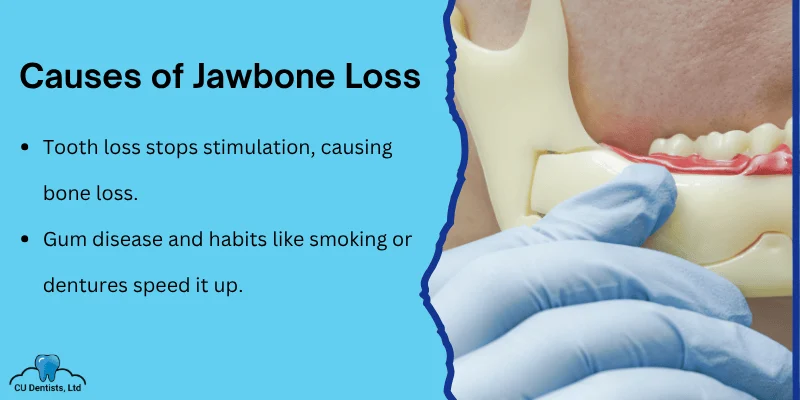
Your jawbone needs regular pressure from chewing to stay strong. When you lose a tooth, that pressure stops.
Without stimulation from the tooth root, the body begins bone resorption. This means your body slowly breaks down and absorbs the unused bone. Jaw bone loss can begin within months after tooth loss.
Gum disease and periodontal disease also damage bone. Infection spreads below the gums and destroys the tissue and bone that hold your teeth in place. Over time, this can lead to severe bone loss.
Other factors can affect jawbone health, including smoking, uncontrolled diabetes, and long-term denture use. Each of these can reduce blood flow or increase pressure on certain areas, which speeds up bone loss.
Effects of Bone Loss on Implant Success
Dental implants depend on strong bone for support. The implant post must fuse with your bone in a process called osseointegration.
If you have low bone density or reduced bone volume, the implant may not stay stable during healing. Movement can interrupt osseointegration and increase the risk of implant failure.
Severe bone loss can also limit where your dentist can safely place the implant. In the upper jaw, bone loss may bring the sinus cavity too close to the implant site. In the lower jaw, important nerves may sit closer to the surface.
Modern treatments make implants possible in many cases. Procedures like bone grafting and sinus lifts help rebuild support.
Understanding Bone Density and Volume
When dentists evaluate you for implants, they measure two key factors:
- Bone density – how strong and compact your bone is
- Bone volume – how much height and width your jawbone has
You need enough density for the implant to anchor firmly. You also need enough volume so the implant stays fully surrounded by bone.
Low density can slow healing. Limited volume may require ridge expansion or bone grafting before placement.
Your dentist usually checks bone levels with 3D imaging. These scans show exact measurements, which helps reduce risks and improve outcomes.
Visit our Rantoul, IL dental team to explore solutions for implants with bone loss.
Evaluating Your Jaw for Implants After Bone Loss
You need a clear picture of your jaw before you move forward with dental implants. Your provider will check bone strength, measure bone volume, and decide what steps can make implants stable and safe.

Initial Consultation With an Implant Specialist
You start with a detailed visit with a dental implant specialist or oral surgeon. This visit focuses on your health history, past tooth loss, and any gum disease or denture use.
Your implant specialist will examine your gums and feel the shape of your jawbone. They look for thin areas, soft tissue changes, and signs of active infection. Healthy gums matter because infection can lower implant success.
You should expect clear questions about smoking, diabetes, and medications. These factors affect healing and bone growth.
Bring a list of symptoms like loose dentures or jaw pain. The more details you share, the better your treatment plan will match your needs.
Imaging and Bone Assessment
Your provider cannot judge bone loss by sight alone. They use 3D imaging, often a cone beam CT scan, to measure jawbone density and height.
This scan shows:
- Bone width
- Bone height
- Bone thickness
- Location of nerves and sinuses
3D imaging helps your oral surgeon see weak areas and plan exact implant placement. It also shows whether you need bone grafting or a sinus lift.
Your implant specialist measures jawbone density to check if it can hold a titanium post. Dense bone supports faster integration. Softer bone may require added support or a different implant type.
Accurate imaging lowers surgical risks and improves long-term stability.
Candidacy for Dental Implants With Bone Loss
Bone loss does not always rule you out. Your candidacy depends on how much bone remains and where the loss occurred.
You may qualify for:
- Bone grafting to rebuild thin areas
- All-on-4 style implants that use angled placement
- Zygomatic implants for severe upper jaw loss
Your dental implant specialist will match the solution to your bone pattern. For example, mild horizontal loss may only need a small graft. Severe vertical loss may require staged treatment.
You also need healthy gums and good daily oral care. Stable medical conditions and a commitment to follow-up visits improve your outcome.
A careful evaluation gives you a clear path forward instead of guesswork.
Book a consultation to see if you qualify for implants despite bone loss.
Treatment Solutions for Getting Dental Implants With Bone Loss
You can still get dental implants with bone loss by rebuilding bone, using different implant designs, or placing implants in stronger areas of your jaw.
Your dentist will choose the method based on how much bone you have and where the loss occurred.
Bone Grafting Procedures
A bone graft rebuilds areas where your jaw has become thin or weak. Dentists use bone grafting to add volume and strength before placing standard implants.
You may receive one of these graft types:
- Autograft – bone taken from your own body
- Allograft – bone from a human donor
- Xenograft – bone from an animal source
- Synthetic bone materials
During bone augmentation, the dentist places graft material into the weak area. Over several months, your body forms new bone around it. This process creates a stable base for implants.
If your jaw ridge has shrunk in width, your dentist may recommend ridge augmentation. This widens the ridge so implants fit securely.
Many patients who need dental implants with bone loss start with grafting to improve long‑term stability.
Sinus Lift and Sinus Augmentation
If you lost bone in your upper back jaw, your dentist may suggest a sinus lift procedure, also called sinus augmentation. This treatment adds bone below your sinus cavities to support implants.
Your dentist gently lifts the sinus membrane and places graft material into the space. Over time, new bone forms in that area. This allows you to place standard implants where bone was once too thin.
You often need a sinus lift when your upper molars have been missing for a long time. Bone in this area shrinks quickly after tooth loss.
Healing usually takes several months. After that, your dentist places the implant into the strengthened bone.
Zygomatic and Pterygoid Implants
When bone loss is severe, your dentist may avoid grafting and use longer implants placed in stronger facial bones.
Zygomatic implants anchor into your cheekbone instead of your upper jaw. The cheekbone keeps its density even when the jaw shrinks. These implants are longer than standard implants and work well for major upper jaw bone loss.
Pterygoid implants anchor into the pterygoid bone behind your upper jaw. This area often has solid bone, even when other areas do not.
These options reduce the need for large bone grafts. Your dentist will use detailed scans to plan safe placement.
Mini and Angled Implants
If you have mild to moderate bone loss, smaller or specially positioned implants may work.
Mini dental implants are thinner than standard implants. They need less bone width and often avoid grafting. Some patients choose mini implants for denture support because placement is less invasive.
Angled implants tilt to use stronger areas of existing bone. This technique helps avoid sinus cavities or nerve areas. Dentists also use longer implants to reach deeper, denser bone when possible.
In rare cases, subperiosteal implants sit on top of the jawbone under the gum instead of inside it. Dentists consider this option when bone height is very limited.
These designs expand your choices if you want to get dental implants with bone loss without extensive surgery.
The Dental Implant Process With Bone Loss
When you have bone loss, your dentist adjusts each step of implant placement to protect your jaw and improve stability. You may need added procedures before implant surgery, and your healing time may be longer than usual.
Preparation and Timing
Your dentist starts with a full exam, X-rays, and often a 3D scan. These images show how much bone you have and where implant placement is possible.
If your jaw lacks enough bone, you may need a bone graft first. The graft adds volume and strength to support the implant. Bone graft healing often takes 3 to 6 months, depending on the size and location of the graft.
For upper back teeth, your dentist may suggest a sinus lift to create space for new bone. In some cases, options like mini implants or all-on-4 dental implants reduce the need for large grafts.
If bone loss is severe in the upper jaw, your provider may discuss alternatives such as zygomatic dental implants, which anchor in the cheekbone instead of the jaw.
You and your dentist will plan the timing carefully. Rushing this stage can increase the risk of implant failure.
Implant Surgery and Placement
During implant surgery, your dentist places a small titanium post into your jawbone. This post acts as an artificial tooth root.
If you had a bone graft, the dentist confirms that the graft has healed before surgery. In some cases, the graft and implant placement happen at the same visit, but this depends on your bone condition.
The procedure usually takes one to two hours per implant. You receive local anesthesia, and some offices offer sedation for comfort.
For patients missing many teeth, your dentist may suggest implant-supported dentures or all-on-4. With all-on-4 dental implants, four implants support a full arch of teeth.
This method can limit the number of implants and reduce treatment time.
After surgery, your jaw begins a process called osseointegration. Your bone grows around the implant and locks it in place.
Abutments, Crowns, and Final Restoration
Once the implant bonds with your bone, your dentist places an abutment. The abutment connects the implant to your new tooth.
This step may require a minor procedure to expose the implant if it sits under the gum. Healing after abutment placement usually takes about two weeks.
After your gums heal, your dentist takes impressions or digital scans. A dental lab then creates your custom crown, bridge, or denture.
You may receive:
- A single crown for one missing tooth
- A bridge instead of traditional dental bridges that rely on natural teeth
- Implant-supported dentures for full tooth replacement
Your final restoration matches the shape and color of your natural teeth. It should feel stable when you chew and speak.
Healing and Recovery Time
Healing time depends on your bone health and the procedures you needed. If you had a bone graft, dental implant recovery time may extend several months before implant placement even begins.
After implant surgery, most people return to normal activities within a few days. Mild swelling, bruising, and soreness are common but manageable with medication and soft foods.
Full bone integration usually takes 3 to 6 months. During this time, you may wear a temporary tooth replacement so you do not go without teeth.
Good oral hygiene is critical. You must brush, floss, and attend follow-up visits to protect the implant and surrounding bone.
Your dentist will monitor your healing closely to ensure the implant remains stable and your jaw continues to support it.
Maintaining Your Implants and Jawbone Health
Your daily habits and regular dental visits play a direct role in how long your implants last. Good care supports jawbone health, lowers your risk of infection, and helps prevent further bone loss around the implant.
Importance of Oral Hygiene

You need strong oral hygiene to protect your dental implants. Plaque can still build up around an implant, just like it does around natural teeth.
Brush twice a day with a soft toothbrush. Clean along the gumline where the implant meets the tissue. Use floss, floss threaders, or small interdental brushes to remove debris between teeth and around implant posts.
Poor cleaning can lead to peri-implantitis, an infection that damages gum and bone. This condition can reduce jawbone health and lower your implant success rate.
You should also schedule professional cleanings every 3–6 months, based on your dentist’s advice. Regular exams allow your dentist to check bone levels and make sure the implant remains stable.
How Implants Prevent Further Bone Loss
When you lose a tooth, the jawbone in that area begins to shrink because it no longer receives pressure from chewing. Dental implants replace the missing root and restore that stimulation.
During chewing, the implant transfers force into your jawbone. This helps maintain bone density and slows bone resorption.
However, implants only prevent further bone loss when placed in healthy, stable bone. You still need good oral hygiene and routine care to protect the surrounding tissue.
Factors Influencing Implant Success Rates
Several factors affect implant success rates. Your overall health and daily habits matter just as much as the procedure itself.
Key factors include:
- Bone quality and volume at the implant site
- Gum health before and after placement
- Smoking status
- Control of medical conditions like diabetes
- Consistent oral hygiene
Implant dentistry has high implant success rates when dentists plan carefully and patients follow instructions. Your dentist may use 3D imaging to measure bone and guide placement.
You improve your outcome by attending follow-up visits, wearing any night guard if prescribed, and reporting pain or movement right away. Active care helps protect both your implant and your jawbone for the long term.
Frequently Asked Questions
Bone loss does not always stop you from getting dental implants. You may need added steps like grafting, special implant types, or treatment for gum disease before moving forward.
What options are available for dental implants when experiencing bone loss?
You still have several options, even if your jawbone has shrunk over time.
Many dentists recommend bone grafting to rebuild lost bone. This process adds natural or synthetic bone material to your jaw to create a stronger base.
Some patients may qualify for mini implants. These are smaller in diameter and may work in areas with limited bone.
In certain upper jaw cases, your surgeon may suggest a sinus lift. This procedure raises the sinus floor to make space for more bone.
Is it possible to undergo a dental implant procedure after being diagnosed with periodontal disease?
Yes, but you must treat the gum disease first.
Periodontal disease damages the bone that supports your teeth. If you place implants without controlling the infection, you increase the risk of failure.
Your dentist will clean the infected areas and may use deep scaling or other treatments. After your gums heal and the infection is under control, you can move forward with implant planning.
How does bone loss around existing dental implants affect their stability and what can be done?
Bone loss around an implant can make it loose over time.
This condition, often linked to infection, reduces the support holding the implant in place. Your dentist may clean the area deeply and treat the infection to stop further damage.
In more serious cases, your dentist may need to remove the implant and rebuild the bone before placing a new one.
Are there alternatives like zygomatic implants for those with severe bone loss?
Yes, zygomatic implants offer another option if you have severe upper jaw bone loss.
These implants anchor into the cheekbone instead of the jawbone.
This option usually requires a highly trained oral surgeon and careful planning.
How much might it cost to receive dental implants if bone grafting is required due to bone loss?
Costs increase when you add bone grafting to your treatment plan.
Bone grafting can range from a few hundred to several thousand dollars, depending on how much bone you need. The implant itself may cost between $1,500 and $6,000 per tooth in many cases.
Your total cost depends on the number of implants, imaging, surgery fees, and follow-up visits. Insurance may cover part of the treatment if it is medically necessary.
What steps can be taken if I have insufficient bone density for standard dental implants?
First, your dentist will take X-rays or a CT scan to measure your bone levels.
If your bone density is too low, you may need a graft and several months of healing before implant placement.
You can also improve your outcome by quitting smoking, keeping your gums healthy, and following all pre- and post-surgery instructions closely.