


You can replace a whole arch of missing teeth with just four implants placed to support a fixed set of replacement teeth, giving you stable chewing, a natural look, and a faster timeline than many full-mouth options.
All-on-4 dental implants often let you leave surgery with working teeth the same day and a plan for a durable final prosthetic after healing.
This treatment suits people who want a long-term, low-maintenance alternative to removable dentures and who have enough bone or can avoid extensive grafting. You will learn what the procedure involves, who makes a good candidate, common benefits and risks, and how care affects long-term results.
Key Takeaways
- A full arch can be rebuilt using four strategically placed implants.
- The process often provides same-day temporary teeth and a shorter overall timeline.
- Long-term success depends on proper planning, good oral hygiene, and regular follow-up.
What Are All-on-4 Dental Implants?
All-on-4 replaces a full arch of missing teeth using only four implants to hold a fixed set of prosthetic teeth. You get a stable, non-removable bridge anchored to the jawbone that feels more like natural teeth than a denture.
Core Concept and Design
All-on-4 uses four dental implants placed in specific spots to spread bite forces evenly. Two implants go near the front of the jaw and two are tilted toward the back at about 30–45 degrees. This tilt helps avoid sinuses in the upper jaw and the nerve canal in the lower jaw, so you often don’t need bone grafts.
Your prosthetic teeth attach to a metal framework fixed to those implants. You usually leave surgery with a temporary bridge and get a custom final prosthesis after healing. Materials include titanium for implants and acrylic or zirconia for the prosthetic teeth.
Differences from Traditional Implants
Traditional full-arch restorations often use six to eight implants or one implant per missing tooth. Those approaches can need bone grafting and more surgeries. All-on-4 cuts the number of implants and can shorten treatment time and cost.
Functionally, All-on-4 gives you a fixed arch; no daily removal like with dentures. That stability improves chewing and speech. Long-term care still requires daily cleaning and regular checkups to protect gum health and implant stability.
Terminology: All-on-4 vs. All-on-Four
People use “All-on-4” and “All-on-Four” interchangeably. Both refer to the same technique of four implants supporting a full-arch prosthesis. Some clinics brand their version with capital letters or trademark names, but the basic idea remains four implants supporting fixed prosthetic teeth.
When you compare offers, watch for differences in materials, number of follow-up visits, and whether a temporary prosthesis is included. Those details affect comfort, cost, and outcome more than whether the name is spelled with a numeral or words.
Benefits of All-on-4 Dental Implants
All-on-4 implants give you a fixed full-arch solution that restores chewing, speech, and facial support. In a longitudinal All-on-4 study (JADA), prosthesis survival was 99.2% up to 10 years; implant-related success reported 94.8% up to 10 years.
They can look like natural teeth, protect jaw bone, and often need fewer surgeries than traditional implant methods.
Restoring Functionality and Aesthetics
All-on-4 replaces a full arch using just four implants to hold a fixed bridge. You regain strong biting force so you can eat nuts, apples, and other foods that are hard with dentures. The prosthesis is custom-made to match your tooth shape, color, and bite. This helps produce a natural-looking smile and clearer speech.
Because the bridge is fixed, it won’t shift during talking or eating. Many people report faster confidence with social activities and daily life compared to removable dentures. Your dentist adjusts the prosthesis to give balanced chewing across the arch and to keep your jaw comfortable.
Bone Preservation and Preventing Bone Loss
Dental implants act like tooth roots and send normal chewing forces into the jaw. That stimulation helps slow or stop the bone loss that follows tooth loss. All-on-4 places implants at strategic angles to engage denser bone, which often avoids the need for bone grafting.
By preserving bone height and width, implants help maintain your facial shape and reduce the sunken look that can come with long-term denture wear. This facial support improves aesthetic results and makes full mouth restoration look more natural over time.
High Success Rate and Long-Term Outcomes
All-on-4 has strong clinical records when planned and placed by experienced clinicians. Implant osseointegration (the bone bonding to the implant) usually succeeds when you follow post-op care and maintain oral hygiene. With proper cleaning and regular checkups, many patients keep functional implant-supported bridges for decades.
Long-term outcomes depend on your health, smoking status, and maintenance. Regular professional cleanings, daily brushing under the prosthesis, and avoiding excessive forces all raise the chance of lasting success. Your dentist can monitor and repair the prosthesis if wear or damage occurs.
Cost-Effectiveness and Convenience
All-on-4 can lower total treatment time and often costs less than placing many individual implants for a full arch. Fewer implants, reduced need for bone grafts, and the potential for same-day provisional teeth all shorten treatment stages. That saves you time off work and fewer surgical visits.
You often receive a temporary fixed bridge the same day as surgery, so you leave with teeth that look and function. Over time, lower maintenance and fewer replacements compared with removable dentures can make All-on-4 a practical choice for full-arch rehabilitation. For clear pricing and options, consult a qualified implant team to get a personalized plan.
Not sure if All-on-4 is right for you? Request a consult and get a step-by-step treatment plan.
Candidacy and Treatment Planning
You need to know who qualifies, how bone and gum health affect the plan, and what imaging and exams your clinician will use to design the treatment.
Who Is a Good Candidate?
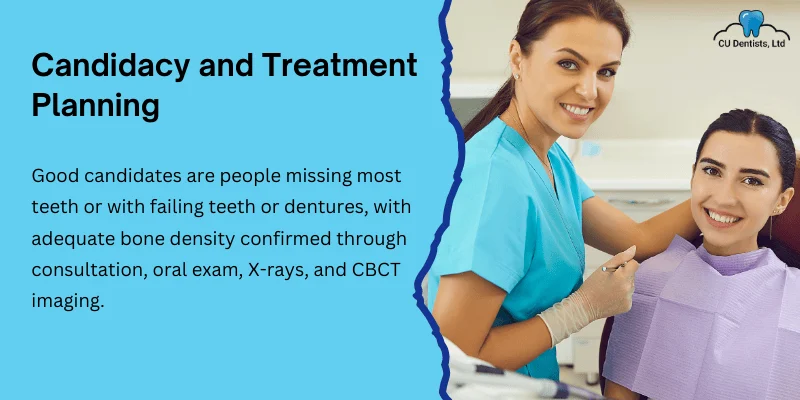
You are a good candidate if you need a full-arch replacement and want a fixed set of teeth that won’t be removed daily. Ideal candidates include people who are missing most or all teeth in the upper or lower arch, have failing teeth that need extraction, or wear full dentures and want more stability.
You must be in generally good health or have medical conditions controlled by your doctor. Uncontrolled diabetes, recent cancer radiation to the jaw, or active infections usually need treatment or stabilization first.
Key practical factors clinicians check:
- Your ability to maintain daily oral hygiene.
- Willingness to stop smoking around surgery.
- Parafunctional habits (like heavy teeth grinding) that may need a night guard or additional design changes.
Role of Bone Density and Oral Health
Bone density and volume determine implant placement and whether angled posterior implants can avoid grafting. Your jaw needs enough height and width in the front jaw area; if bone is low, the All-on-4 approach often uses tilted back implants to reach denser bone and reduce the need for grafts.
Active gum disease must be treated before implants. Healthy gums lower the risk of infection and long-term implant failure. If you have a history of periodontal disease, your dentist may plan periodontal therapy first and set stricter maintenance visits after surgery.
Practical checks include:
- Measurements of bone height and width.
- Assessment of gum pocket depths and bleeding.
- Review of medications that affect bone healing.
Comprehensive Consultation and Diagnostic Imaging
Your consultation will combine a medical and dental history review, oral exam, and imaging. Expect a full dental X-ray set and a cone beam CT (CBCT) scan for 3D bone mapping. The CBCT shows bone density, sinus positions, and nerve locations so your clinician can plan exact implant angles and prosthesis design.
Treatment planning also covers prosthetic goals (fixed vs. removable temporary), surgical timing, and cost breakdown.
Your team will document parafunctional habits and may recommend a night guard or muscle management if you grind. They will also discuss anesthesia options and a post-op hygiene schedule tailored to your needs.
Important items they will give you:
- A written treatment plan with implant positions and timeline.
- Imaging printouts or digital files showing planned implant angulation.
- Instructions for pre-op health steps, like stopping certain meds or smoking.
All-on-4 Dental Implant Procedure
This procedure replaces a full arch with four to six implants placed in specific positions, then fits a temporary set of teeth while the implants heal and later a permanent bridge is attached. You will go through evaluation, guided implant surgery, a healing phase with a temporary prosthesis, and finally placement of a final prosthesis after osseointegration.
Initial Evaluation and Surgical Planning
You start with a detailed exam and imaging. Your dentist or oral surgeon will take 3D cone-beam CT scans and bite records to measure bone height, width, and nerve positions. The team checks for infection, remaining teeth that need extraction, and whether you need bone grafting or sinus augmentation first.
Your medical history and smoking status matter because they affect healing. The clinician makes a digital plan showing exact implant angles and lengths. This plan decides whether you need local anesthesia with sedation or general anesthesia on the day of surgery.
A surgical guide is designed from the plan. The guide maps implant positions and helps protect nerves and the sinus. It also speeds surgery and improves accuracy for full-arch restoration.
Implant Placement and Use of Surgical Guides
On surgery day, you receive anesthesia chosen in planning (local with IV sedation or general anesthesia) so you stay comfortable. Your surgeon removes failing teeth if needed, then places four (sometimes six) titanium implants into the jawbone in precise locations.
Angled posterior implants often avoid bone grafts by using the denser front bone. If your scans showed low bone volume, the plan may include bone grafting or a sinus lift before or during surgery. The surgical guide fits over your jaws and directs drill depth and angle, reducing guesswork.
After placing implants, the surgeon secures healing caps. You may get antibiotics and pain meds. The whole implant surgery usually completes in a single session for one arch.
Temporary Prosthesis and Healing Phase
Soon after implant placement (sometimes the same day) you will receive a temporary prosthesis attached to the implants. This temporary bridge restores function and appearance while the bone heals. It is typically made of acrylic or composite and is lighter than the final prosthesis.
You must follow a soft-food diet for the first few weeks and avoid heavy biting on the temporary. Good oral hygiene and follow-up visits let the team check for signs of infection, proper fit, and early implant stability. Smoking or poor control of diabetes can lengthen the healing period.
Osseointegration begins during this phase as the bone bonds to the implant surface. That bonding usually takes 3 to 6 months, depending on bone quality and whether grafts were used.
Final Prosthesis and Osseointegration
Once your surgeon confirms stable osseointegration, they remove the temporary and take precise impressions or digital scans for the final prosthesis. The final bridge is custom-made from stronger materials like titanium frameworks with porcelain or high-grade acrylic teeth.
The final prosthesis is fixed to the implant abutments and adjusted for bite, speech, and comfort. Your provider will teach you cleaning techniques for a fixed full-arch restoration, including interdental brushes and flossing around abutments.
Long-term success depends on regular checkups, good oral hygiene, and avoiding habits that stress implants. If bone grafts or sinus augmentation were done earlier, your provider monitors those areas too to ensure lasting support for the final prosthesis.
Care, Maintenance, and Outcomes
You will need steady daily hygiene, short-term wound care, and regular dental visits to protect your implants and the bone that supports them. Small changes to brushing, eating, and scheduling check-ups make the biggest difference in long-term success.

Post-Operative Care and Oral Hygiene
Right after surgery, follow your dentist’s instructions for pain control and swelling: use prescribed meds, ice packs for 15 minutes on/off, and avoid heavy activity for 48–72 hours. Keep gauze in place as directed and report heavy bleeding or fever.
Clean gently while tissues heal. Use a soft-bristled toothbrush and irrigate under the prosthesis with a water flosser on low. Rinse with an alcohol-free antimicrobial mouthwash if recommended. Avoid probing surgical sites for the first week; after that, begin careful interdental brushing and floss threaders to remove food under the bridge.
Watch for persistent pain, increasing redness, or pus. These signs can mean infection or early peri-implantitis, which needs prompt care to protect bone and implants.
Dietary Guidelines and Soft Diet
Follow a soft diet for the first 1–2 weeks to avoid pressure on new implants. Eat mashed potatoes, scrambled eggs, yogurt, smoothies, and soft-cooked vegetables. Cut food into small pieces and chew on the opposite side if only one arch was treated.
Avoid hard, sticky, or crunchy foods (nuts, hard candies, tough meat, chewing gum) for at least a month. Do not use your teeth as tools. Hot beverages are fine after numbness wears off, but sip slowly to avoid burns.
After initial healing, reintroduce firmer foods gradually. If you grind or clench, ask your dentist about a nightguard to protect the prosthesis and reduce bone stress that can lead to wear or bone resorption.
Dental Check-Ups and Monitoring
Schedule follow-ups at the intervals your dentist sets; commonly at 2 weeks, 3 months, and then every 3–6 months. These visits let your clinician check implant stability, occlusion (bite), soft tissue health, and bone levels with periodic X-rays.
Professional cleanings remove calculus under the prosthesis that you cannot reach at home. Your dentist may remove the prosthesis to inspect attachments, tighten fixation screws, or replace worn components like O-rings.
Bring up any new mobility, clicking, or changes in bite right away. Early detection of problems such as peri-implant bone loss lets your team treat issues before they progress.
Managing Potential Risks and Implant Failure
Know the common risks: infection (peri-implantitis), mechanical loosening, prosthesis wear, and gradual bone resorption. Smoking, poor oral hygiene, uncontrolled diabetes, and heavy bruxism raise your risk for implant failure.
If you notice bleeding gums, bad breath, gum recession, or implant mobility, call your dentist immediately. Treatment may include cleaning under the prosthesis, antibiotics, adjusting bite forces, or replacing worn parts. In advanced cases, bone grafting or implant removal may be required.
Maintain excellent oral hygiene daily, keep regular dental visits, and follow lifestyle advice (quit smoking, control systemic health) to lower your chance of major problems and protect the implants and supporting bone for years to come.
Comparing All-on-4 to Alternative Tooth Replacement Options
All-on-4 often gives a faster, fixed solution for a full arch using fewer implants. Costs, feel, bone health, treatment time, and long-term maintenance differ a lot between options.
Traditional Dentures vs. All-on-4
Traditional dentures sit on your gums and can be removed each day. They cost less upfront and are non-surgical, but they can slip, cause sore spots, and speed bone loss in the jaw over time. You may need adhesives and periodic relines as bone shrinks.
All-on-4 uses four implants to support a fixed arch. That gives you more stability when eating and speaking and slows bone loss by transferring chewing forces to the jaw.
The procedure is surgical and costs more up front, but you avoid daily removal and most adhesive needs. Not everyone qualifies; poor bone or certain medical issues may require grafting or another plan.
All-on-4 vs. Conventional Implants
Conventional implants replace single teeth or support bridges with one implant per tooth. They feel very natural and preserve bone well around each replaced root. Treatment often takes longer and costs more if you need to replace a whole arch, because many implants are required.
All-on-4 replaces a full arch with only four implants placed at angles to use existing bone. You get faster restoration and lower implant count, which can reduce cost and surgery time. However, if one implant fails, the prosthesis may need repair or adjustment. Both approaches have high success when done by experienced clinicians.
Other Dental Implant Systems and Technologies
Other systems include fixed implant bridges, removable implant-retained dentures, and newer guided-surgery workflows and materials. Fixed implant bridges use multiple implants like conventional implants but join crowns into one prosthesis for strength.
Removable implant dentures snap on and off; they improve retention over traditional dentures but still allow removal for cleaning.
Guided implant placement and modern materials (zirconia, reinforced acrylic) change chair time and esthetics. Ask your clinician about failure rates, warranty, and maintenance plans for any dental implant system. Knowing the expected life span and what happens if an implant fails helps you choose the right path.
Frequently Asked Questions
This section answers practical questions about implant number, steps, cost ranges, common risks, and insurance. You will find clear comparisons, typical timelines, and places to check for more pricing details.
How do All-on-4 dental implants differ from traditional implants?
All-on-4 uses four implants to support a full arch of fixed teeth. Traditional implant plans often place one implant per missing tooth or use more implants for an arch.
All-on-4 places the two back implants at a tilt to use more jawbone and avoid sinus or nerve areas. That often reduces the need for bone grafts and lets you get a fixed temporary set the same day.
You get fewer implants, shorter surgery time, and usually lower material costs compared with full individual implants. Stability and chewing strength are similar to many multi-implant setups when planned correctly.
Can you explain the step-by-step procedure of getting All-on-4 dental implants?
First you will have a consultation with 3D imaging and health review to check bone, sinuses, and nerves. Your dentist or surgeon will plan implant positions using the scans.
Next they remove any failing teeth and place four titanium implants in the jaw. The two posterior implants are often angled to maximize bone contact.
After implant placement, a temporary fixed prosthesis is attached the same day in many clinics. You follow a healing period of a few months while the implants integrate with bone.
Finally, your team fits a final custom prosthesis once osseointegration is stable. Regular checkups and cleaning keep the implants healthy.
What is the average cost of All-on-4 dental implants?
Costs vary widely by country, clinic, and materials. In the U.S., expect a range roughly from several thousand to tens of thousands of dollars per arch depending on the prosthesis type and any extra work.
Factors that change price include imaging, anesthesia, extractions, temporary teeth, and whether high-end materials or labs are used. Check local clinics for firm quotes and ask what the price covers.
Are there any common complications associated with All-on-4 dental implants?
Common short-term issues include swelling, bruising, and mild pain after surgery. These usually clear in days to weeks with standard care.
Possible complications include infection, implant failure if bone doesn’t integrate, or nerve changes such as numbness. Choosing an experienced surgeon and following aftercare lowers these risks.
Long-term risks can include prosthesis wear or need for repairs. Regular dental visits and good oral hygiene reduce the chance of problems.
How do All-on-6 dental implants compare to All-on-4?
All-on-6 uses six implants to support a full arch, giving more implant support and potentially more load distribution. That can be useful if you have higher bite forces or want extra redundancy.
All-on-6 may require more bone and can raise cost and surgery time versus All-on-4. Both approaches aim for fixed teeth; your clinician will choose based on bone quality, budget, and functional needs.
Does Medicare cover any portion of the cost for All-on-4 dental implants?
Original Medicare (Parts A and B) generally does not cover routine dental care or implant procedures. That means most All-on-4 costs are not covered by Medicare alone.
Some Medicare Advantage plans offer limited dental benefits that might cover parts of exams or X-rays, but coverage for implants is rare. You should contact your plan for specific benefits and verify any dental riders.